17May

Prevailing Wage Estimation for Fair Compensation

What is Prevailing Wage Estimation?

What is Prevailing Wage Estimation

  1. Base Wages: Local market forces determine professionals’ base wage (Hourly rate).
  2. Fringe Benefits: Fringe Benefits Include Health Insurance, Retirement Contributions, and Training Funds.
  3. Overtime and Premium Pay: Workers receive increased rates beyond regular pay when they perform overtime work and when they work on special days such as weekends or holidays.
  4. Travel and Per Diem: The allowance system includes travel and Per Diem payments that enable workers to cover their daily expenses when they perform tasks outside their normal work region.
  5. Escalations and Increases: Escalations and increases are defined by the application of scheduled wage increases that appear in prevailing wage laws.

Accurate estimating of these components is essential to comply with legal requirements and maintain project budgets.

Importance of Prevailing Wage Estimation

1. Ensuring compliance

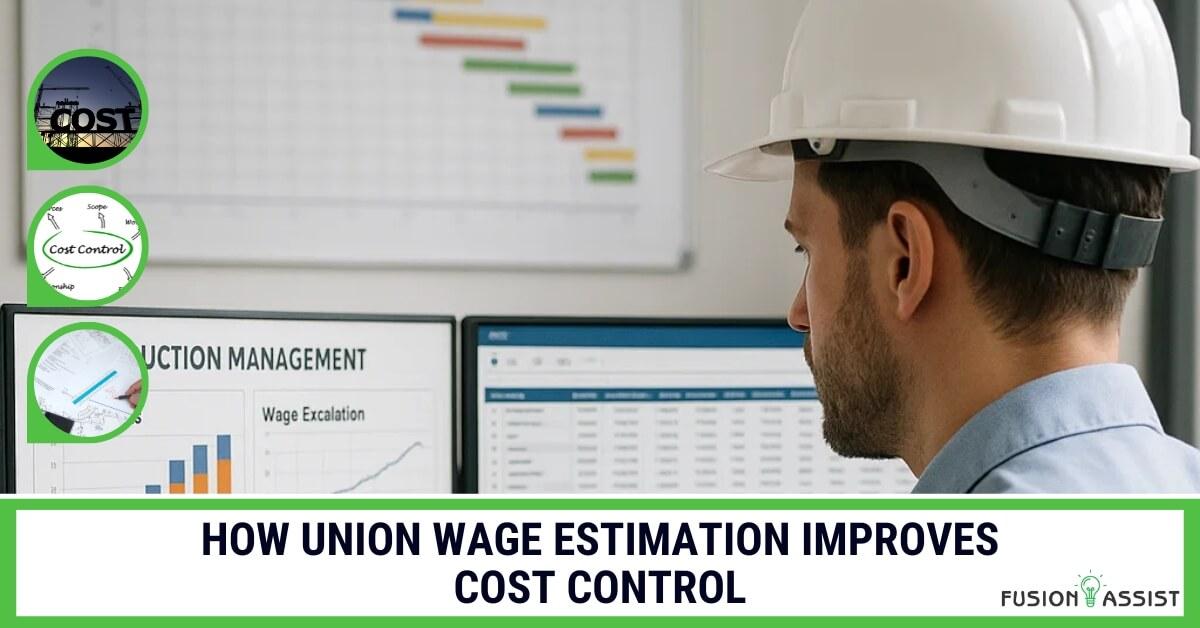
2. Cost Control

3. Fair Compensation

4. Competitive Bidding

5. Building Trust

Components of Prevailing Wage Estimation

Key components of prevailing wage estimation including base wages, fringe benefits, overtime pay, travel allowances, and wage escalations.

1. Base Wages

Wages that form the foundation start from what the local market accepts, and they change based on occupation, experience levels, and geographic areas. Accurate estimation depends on maintaining current wage rate information about particular job classifications.

2. Fringe Benefits

Employee fringe benefits include health insurance, retirement contributions, vacation pay, and training funds. These benefits greatly influence labor costs, so their precise estimation becomes essential for staying compliant.

3. Overtime and Premium Pay

Wage estimation must include all premium pay rates, including holiday and weekend double-time payments. The failure to accurately consider such conditions results in significant budget overruns and possible legal complications.

4. Travel and Per Diem

Employees working outside their local area need travel allowances and per diem expenses. The overall labor budget requires including these costs to ensure accurate budgeting of all expenses.

5. Escalations and Increases

The budget for multi-year projects requires inclusion of wage increases that prevailing wage laws require. Proper projection methods for wage rises protect project funding stability throughout the project.

Challenges in Prevailing Wage Estimation

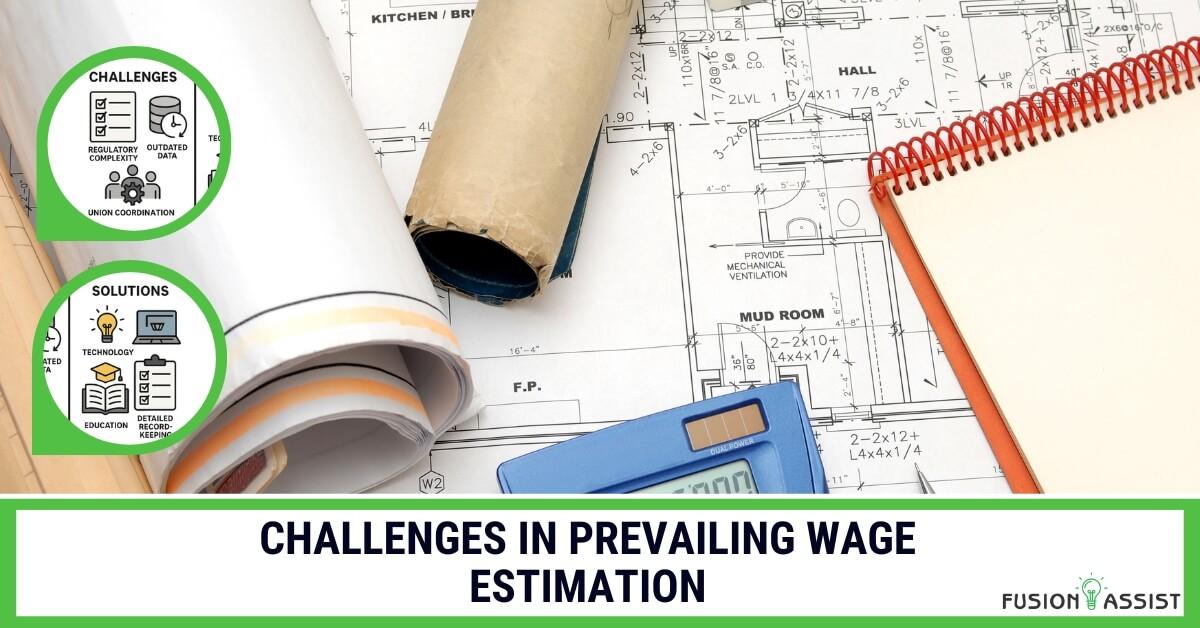
Common challenges in prevailing wage estimation for public construction projects including regulatory complexity, data accuracy, and labor fluctuations.

1. Regulatory Complexity

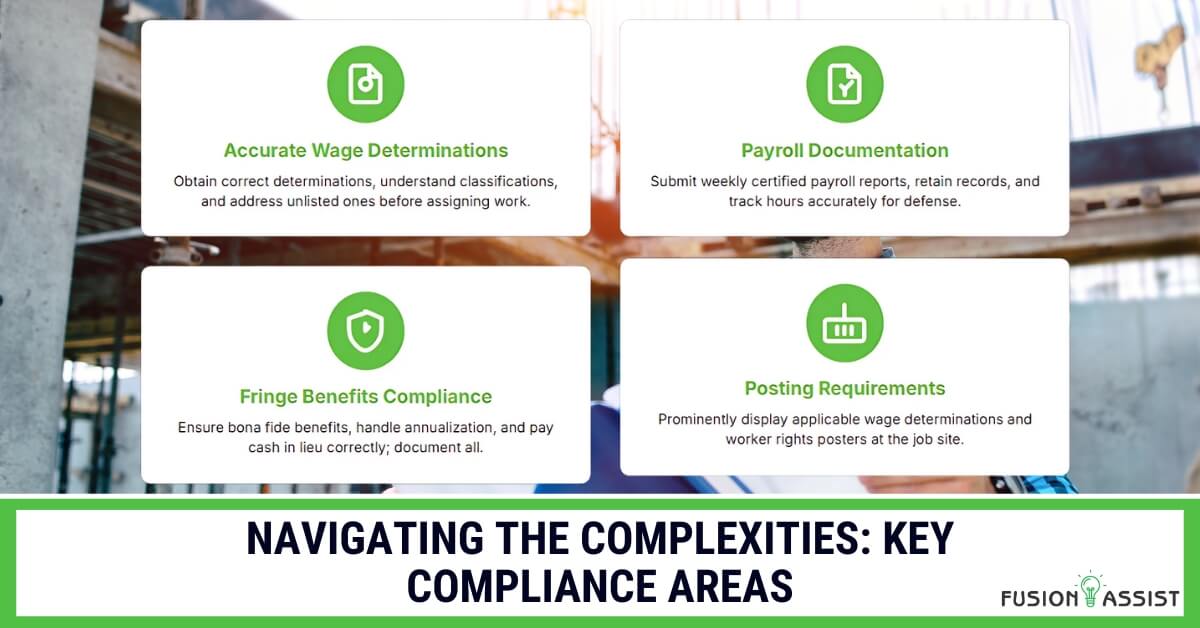
Prevailing wage laws have intricate rules that differ between regional jurisdictions. Full legal comprehension, together with continuous research, is essential to complying with these laws.

2. Data Accuracy

Wage estimation depends on access to dependable, constantly updated information. Using outdated or inaccurate information can lead to financial problems and non-compliance.

3. Labor Market Fluctuations

Rapid changes in labor market conditions directly impact the current wage rates paid in the market. Contractors must maintain awareness about prevailing market conditions and modify their cost projections.

4. Multi-Union Projects

Multiple union projects need precise coordination between builders to maintain compliance with independent union requirements. When management performs the project improperly, it causes expensive conflicts and delays.

5. Record-Keeping

Elaborate documentation of wage payments, along with compliance history, is vital for both audits and disputes that may occur. When records are poorly maintained, it leads to legal consequences and financial losses from this negligence.

6. Regular Updates

The information about wages and benefits must be updated frequently to meet the requirements of prevailing wage laws. The project implementation requires quarterly updates alongside benefit adjustments for extended timelines.

7. Use of Technology

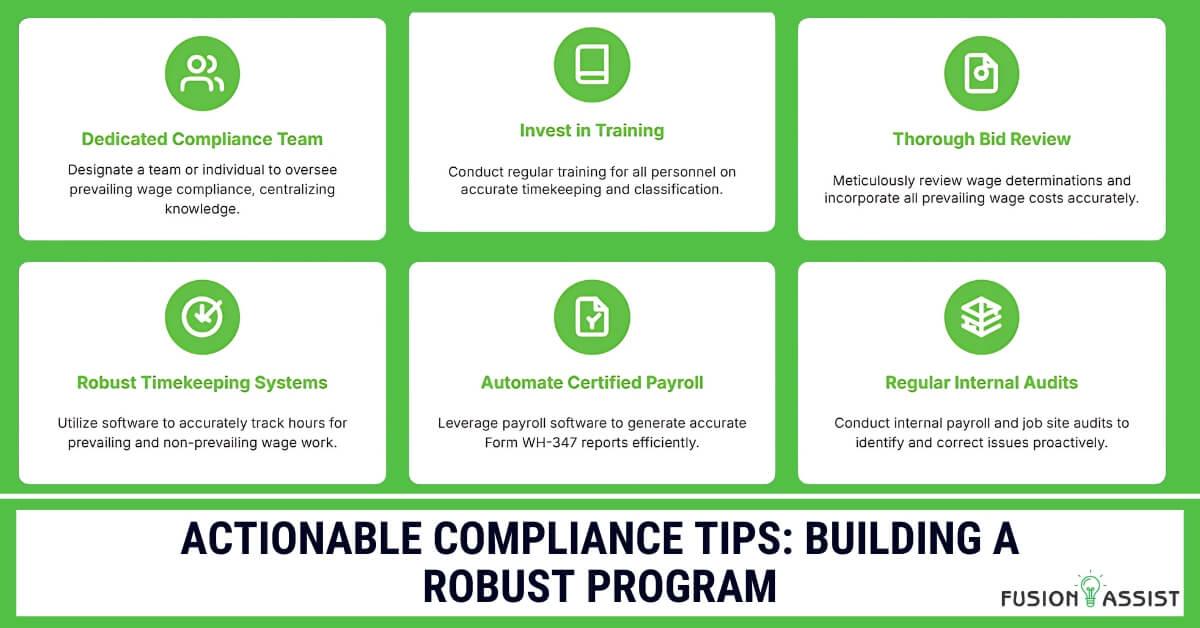
Specialized software and databases should be used to make the estimation process faster while maintaining accuracy. The project estimation tools ProEst and HeavyBid lead to enhanced project efficiency and compliance standards.

8. Detailed Record-Keeping

All wage payments, fringe benefits, and compliance documentation must be documented in great detail. The practice provides organizations with the necessary preparedness to face audits and disputes.

9. Training and Education

The organization should continually educate its staff about prevailing wage laws and estimation methods. The team receives full knowledge of accurate estimation methods because of this system.

10. Collaboration with Unions

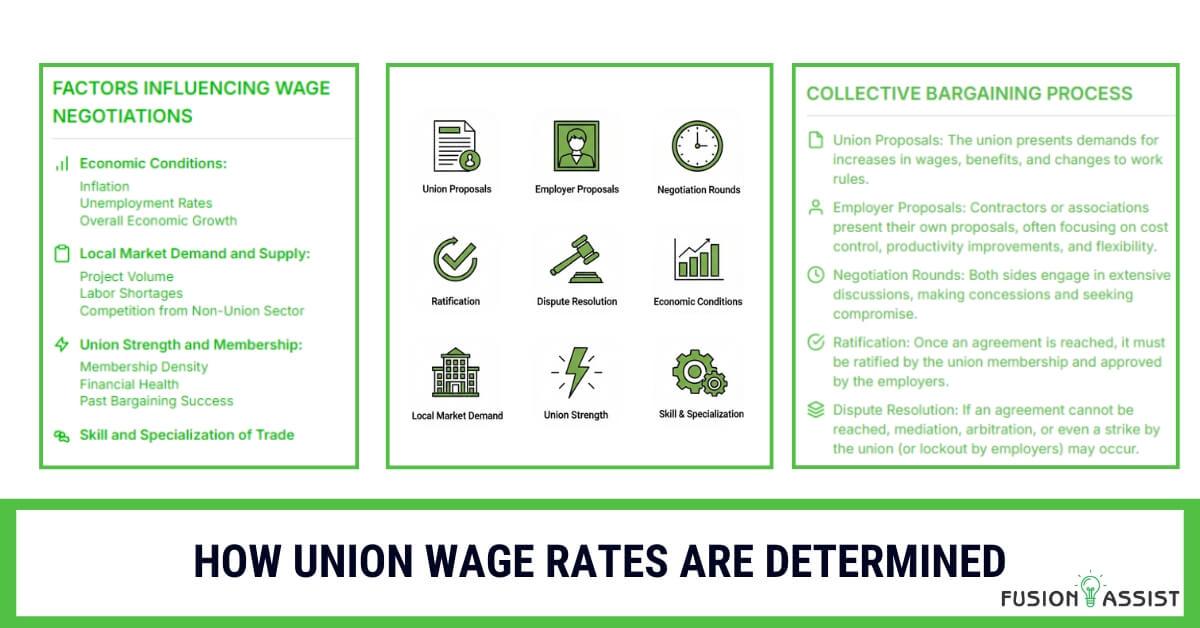
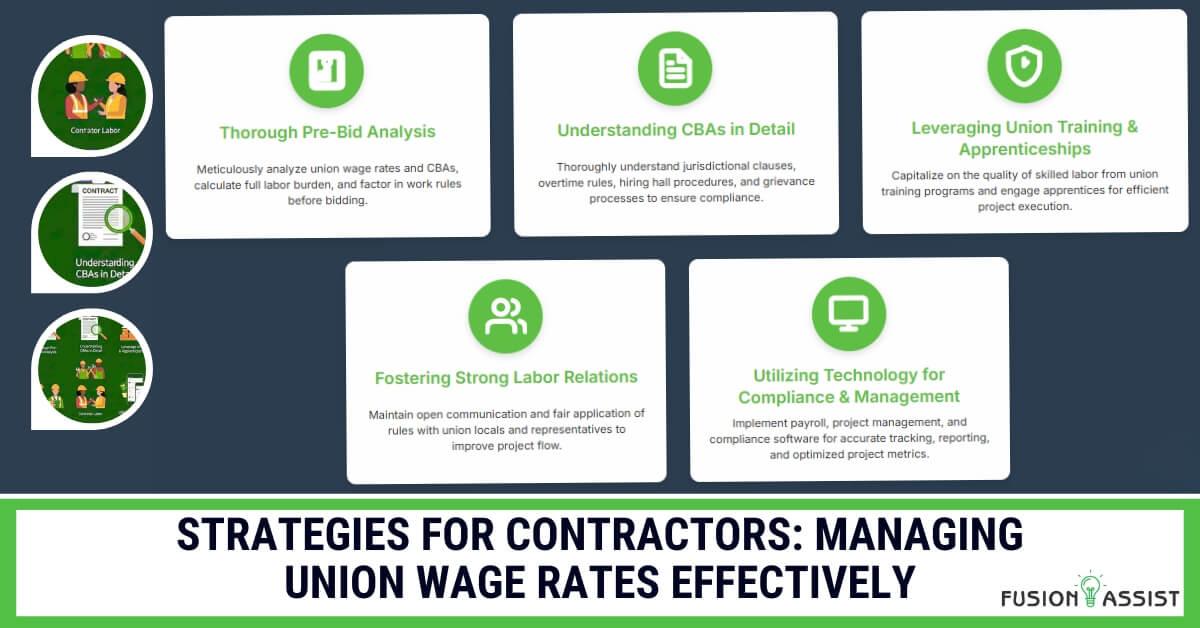
The company should develop close working relationships with labor unions to guarantee understanding and compliance with prevailing wage requirements. Labor disputes, together with positive relations between management and workers, become possible through collaborative efforts.

Case Studies By Fusion Assist

Case Study 1: Public Infrastructure Project – California

Background

Challenge

The project experienced major cost increases, together with compliance risks, because the initial estimates omitted fringe benefits and overtime wages.

Solution

After its implementation, a

Results

Lessons Learned

  • Regular Updates: Wage and benefit data that undergo regular maintenance preserves legal compliance and prevents additional expenses from arising.
  • Use of Technology: Using specialized technology allows organizations to combine software solutions to speed up operations and strengthen precision.
  • Detailed Record-Keeping: Keeping thorough records about everything allows companies to face audits and disputes easily.

Case Study 2: School Construction Project – Florida

Background

Challenge

The project encountered difficulties when assessing fringe benefits and overtime pay, which resulted in budgetary issues at the outset.

Solution

Through a dedicated program, the staff received training about prevailing wage laws and estimation methods

Results

Lessons Learned

  • Accurate Data: Wage data must be accurate and up to date to maintain compliance and control costs.
  • Training and Education: Continuous training programs help the organization’s staff better understand and improve accuracy in wage estimation.
  • Collaboration: The company maintains accurate labor relations through close partnership with labor unions to achieve compliance goals.

Future Trends in Prevailing Wage Estimation

1. AI-Powered Labor Forecasting

AI systems should be used to forecast wage increases, which helps organizations optimize their workforce planning. AI systems generate precise forecasting results by processing historical data and marketplace trends.

2. Blockchain-Based Wage Tracking

Companies should implement blockchain systems to verify wages transparently, thus minimizing fraud and wage disputes. Through blockchain technology, all wage payments and benefits are recorded accurately and securely.

3. Digital CBA Libraries

Fast, error-free estimates can be obtained through machine-readable CBAs. Digital libraries function as a source for immediate access to current collective bargaining agreements.

4. Predictive Compliance Modeling

Project planning stages should use AI modeling to detect upcoming compliance risks. Predictive models detect upcoming issues at a stage where they would cost less to resolve.

Conclusion

Get in touch today for a personalized prevailing wage estimation solution. Contact Now !!

FAQs

Q1: How do I determine if my project is subject to prevailing wage requirements?

The evaluation of prevailing wage requirements for your project requires a review of both federal and state-specific regulations that apply to it. Projects funded by federal and state governments, as well as public works projects, fall under prevailing wage requirements. A consultation with legal experts and labor compliance specialists will provide necessary clarity about compliance requirements.

Q2: Can I use a general contractor’s wage estimates for my subcontractors?

You should avoid using general contractor wage estimates because this practice leads to misleading data and violations of prevailing wage requirements. Because the labor classifications and fringe benefit arrangements between subcontractors differ, contractors must perform specific wage estimations for every subcontractor to avoid violating prevailing wage laws.

Q3: What are the consequences of underpaying fringe benefits?

The practice of underpaying fringe benefits will produce significant fines, financial penalties, and legal repercussions. Contractors could encounter penalties, back payments, interest charges, and legal action. The practice of underpayment negatively impacts labor unions and worker relationships, resulting in project delays and disputes.

Q4: How can I ensure my wage estimates are accurate for multi-year projects?

The duration of multi-year projects requires contractors to incorporate any wage growth that prevails according to local laws. You should update your wage estimates every time there is an increase in prevailing wage rates or any market adjustments occur. Prediction models and legislative change updates maintain project accuracy throughout their duration.

Q5: What steps can I take to improve transparency with workers regarding prevailing wage compliance?

Better transparency with workers about prevailing wage compliance can be achieved through detailed educational efforts and transparent communications. A transparent work environment can be created by providing wage and benefit details at job sites, frequent updates on compliance, and organized training sessions for workers.

20Apr

Precision Estimation for Successful Construction Projects

Accurate estimation is the primary requirement for running practical construction projects. The process requires precise material, labor, and time cost forecasting to develop an extensive execution guide spanning the entire project duration. Precise estimation enables construction firms and property developers to execute projects within expected timelines and budgets while preventing unexpected financial matters. This article delves into the importance of precision estimation, the consequences of inaccurate estimates, and the tools and techniques used to achieve precise estimates.

Understanding Precision Estimation

Construction planner reviewing a project site estimate with material lists, labor schedules, and cost charts

What is Precision Estimation?

Precision estimation involves accurately predicting construction project costs, resource requirements, and duration. This concept includes four vital elements: material expenditures, labor fees, equipment specifications, and overhead expenses. Precision estimation is vital because it establishes a unified direction that guides project managers, stakeholders, and their workforce.

The Process of Precision Estimation

The process starts by following multiple steps for precision estimation.

  1. Initial Assessment: The assessment stage involves a complete analysis of project goals, requirements, and scope definition.
  2. Data Collection: The second step involves collecting data on materials, labor rates, equipment costs, and all other necessary information.
  3. Analysis and Calculation: The collected data undergoes analysis through specialized software that enables precise calculations
  4. Review and Adjustment: Regular assessment of estimates for monitoring project scope changes and market dynamics, as well as other modifying variables.

Why Precision Estimation is Vital for Your Construction Project

1. Managing Project Costs

A project needs accurate budget cost estimation to handle finances properly. Precision estimation helps in:

  • Accurate Forecasting of Material Costs: Material costs remain accurate in forecasting by precisely identifying the required materials alongside their present market prices through precision estimation.
  • Labor Cost Estimation: Planning workforce requirements becomes possible, along with labor shortage prevention, while avoiding staff excess through precise labor cost predictions.
  • Equipment and Overhead Costs: Detailed estimates of overhead and equipment rental expenses prevent any costs from missing out in the project budget.

2. Managing Project Timelines

Time management plays an identical role in the success of construction projects. Precision estimation helps in:

  • Importance of Timely Completion: Accurate Project estimates help builders finish work according to schedule, fulfill deadlines, and prevent time-consuming delays.
  • Impact of Delays on Project Costs: Delays create higher labor costs with material price changes, which result in increased overhead expenses. Precision estimation helps organizations reduce these potential threats.

3. Risk Mitigation

Precision estimation also plays a crucial role in risk management:

  • Identifying Potential Risks Early: Precision estimation allows for proactive problem-solving and contingency planning by identifying potential issues early.
  • Contingency Planning: Project duration stability results from precise estimates, which create extra funds for unforeseen expenses and project delay situations.

Consequences of Inaccurate Estimation

1. Cost Overruns

The use of incorrect estimates creates a massive increase in the financial cost of projects.

  • Causes of Cost Overruns: Three major contributors to cost overruns in construction projects are inadequate material cost forecasting, labor shortages, and unpredictable site conditions.
  • Impact on Budget and Financial Health: Cost overruns generate adverse financial effects that produce legal problems and harm organizational reputation and budgetary health.

2. Time Delays

Inaccurate estimates lead to prolonged timelines, which become one of the most critical adverse effects.

  • Causes of Time Delays: The main contributors to time delays include material shortage, labor disputes, and equipment breakdowns.
  • Impact on Project Schedule and Deadlines: Project delays caused by inaccurate estimates result in failed project deadlines, which produce higher labor costs and additional overhead maintenance expenses.

3. Legal and Reputational Risks

Inadequate estimation accuracy produces legal issues as well as reputation damage due to various reasons:

  • Legal Implications of Inaccurate Estimates: Professional estimates that prove incorrect may trigger legal disputes involving clients, subcontractors, and suppliers.
  • Damage to Company Reputation: Repeated problems with cost overruns, together with delays, permanently damage customers’ perceptions of the company, which results in fewer opportunities for business in the future.

Benefits of Precision Estimation

1. Cost Control and Management

Accurate precision estimation provides various advantages that improve cost control and management functions.

  • Preventing Cost Overruns: Implementing accurate cost estimates minimizes cost overruns because every expense gets properly documented.
  • Efficient Resource Allocation: Strategic resource optimization becomes possible through accurate estimates, decreasing waste and improving general efficiency.

2. Time Management

The estimation process with high precision leads to better time management.

  • Preventing Time Delays: Accurate project estimates enable proper task sequencing and resource distribution, which prevents time-based project delays.
  • Effective Task Sequencing and Scheduling: Detailed timelines enable positive task ordering that maintains project speed because tasks are completed in their proper sequence.

3. Improved Decision-Making

Project planning becomes more transparent since precision estimation brings clarity, which allows stakeholders to make well-informed decisions.

  • Transparency and Clarity in Project Planning: Project planning becomes clearer and more transparent when accurate cost and time predictions are made, allowing stakeholders to make well-informed choices.
  • Informed Decision-Making for Stakeholders: Through detailed estimates, stakeholders evaluate project alterations clearly, which helps them choose better options.

Techniques and Tools for Precision Estimation

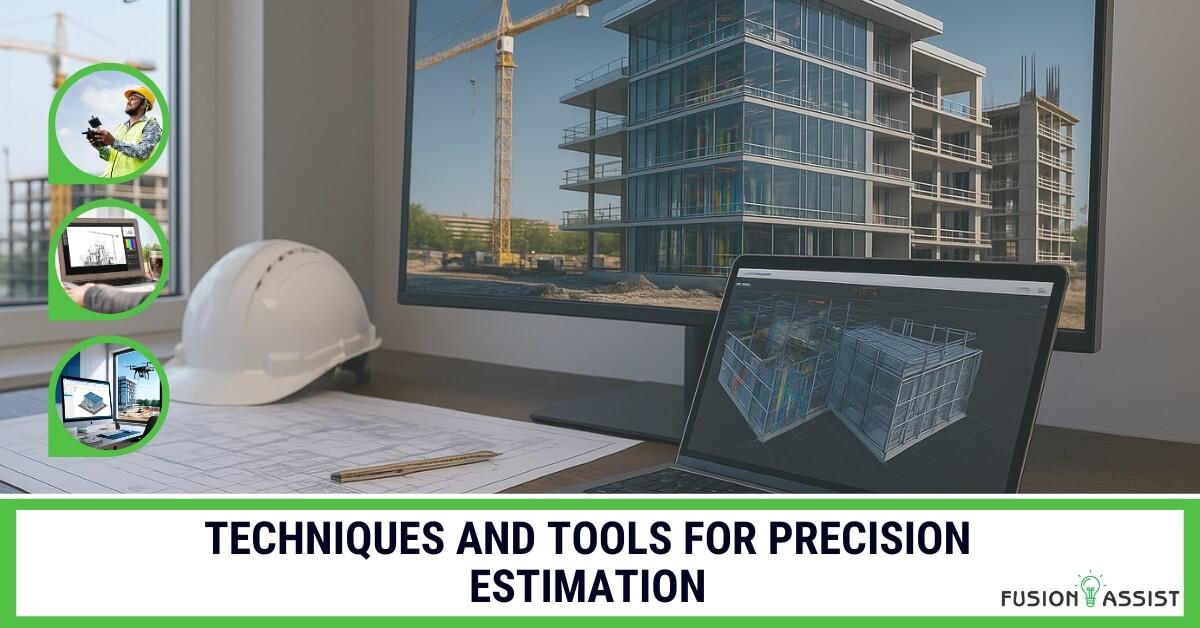
Construction estimation tools and techniques. Construction team using estimation software and BIM on laptops and tablets, with data charts and 3D models on screen.

1. Utilizing the Right Tools

The construction industry depends on sophisticated tools and calculation methods for accurate estimates.

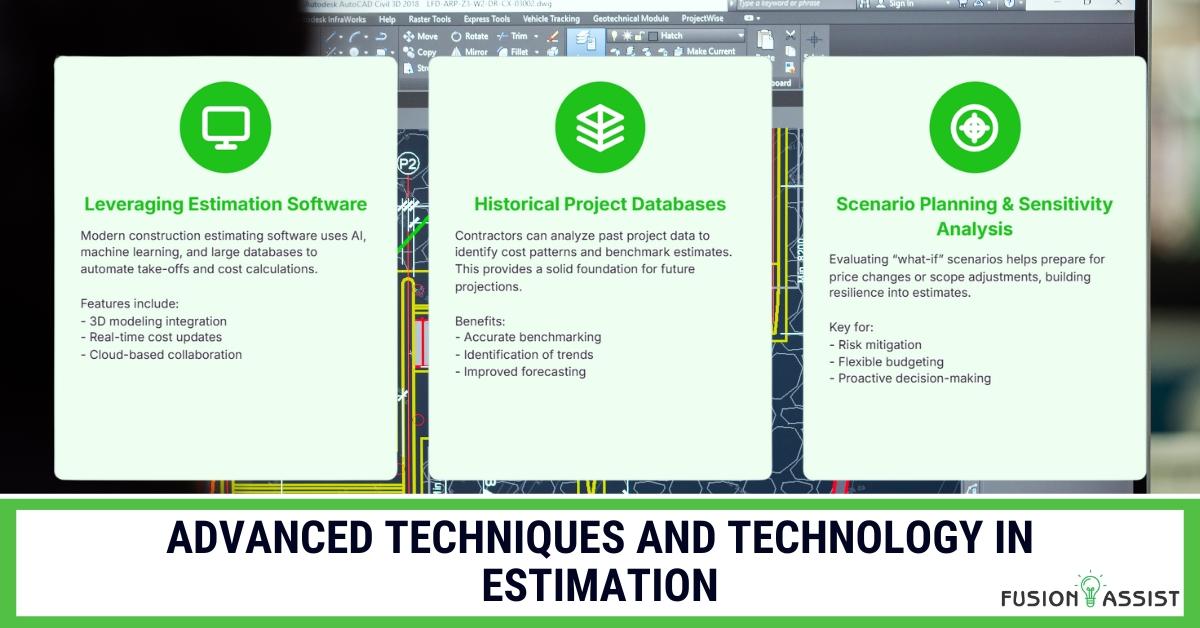
2. Construction Estimation Software

  • Features and Benefits: Modern estimation software performs automatic calculations, reducing human mistakes and speeding up estimation work.
  • Real-Time Adjustments: Software systems enable real-time updates that maintain the most accurate market data and project alterations in current estimates.

3. Building Information Modeling (BIM)

  • Digital Representation and Visualization: Project understanding and communication benefit from Building Information Modeling because it offers detailed digital project models.
  • Integration of Project Data: BIM is a platform that merges project information into one location, thus minimizing data errors.

4. Estimating Strategies

  • Historical Data Analysis: It depends on previous project data to forecast potential cost overruns and project delays.
  • Unit Cost Estimation: The unit cost estimation method enables precise predictions of production unit expenses, ensuring efficient operations.
  • Parametric Estimating: The method of parametric estimating enables the prediction of enormous project costs by applying statistical models between variables and historical data interactions.
  • Combining Techniques for Maximum Accuracy: Multiple estimation methods should be utilized with expert insights to guarantee maximum accuracy in identifying all project requirements during the estimation period.

Advanced Techniques and Technologies

1. Artificial Intelligence and Machine Learning

  • Predictive Analytics: AI algorithms analyze historical data to predict future costs, improving the accuracy of estimates.
  • Risk Assessment: ML models process data to detect potential risks, which they use to propose risk management strategies.
  • Automated Data Processing: Automating extensive data processing using AI technology minimizes both time requirements and human labor needed for estimation tasks.

2. Drones and 3D Scanning

  • Accurate Site Surveys: Drones collect precise site survey data through their high-definition recording systems of work sites.
  • 3D Models for Detailed Measurements: 3D scanning allows for detailed assessments because it develops truthful digital copies of existing structures and sites for accurate measurement.
  • Real-Time Data for Quick Adjustments: These technologies supply real-time data through which estimates get updated swiftly.

Case Studies By Fusion Assist

Case Study 1: Commercial Building Developer

Background

A commercial building developer started a major construction project within an energetic urban district. The development involved residential properties, office spaces, and a shopping center as part of a high-quality construction project in an ideal location. The project demanded immediate completion within a short duration, while the client needed to handle substantial financial elements and strict budgetary constraints.

Challenges

Accurate cost and timeline predictions were the main challenges to overcome for this big and complicated project. The client needed to precisely estimate material costs, labor schedules, and equipment requirements to avoid financial overruns and project delays.

Approach

The team used precision estimation methods based on construction estimation software and Building Information Modeling (BIM) tools. These technological tools enabled the team to achieve precise forecasting results regarding material expenses, labor resources, and equipment rentals. Historical analyses by the project manager enabled the prediction of potential cost risks to deliver budget estimates with greater accuracy.

Results

  • Accurate labor estimates combined with material estimates maintained budget control, which prevented typical budget overruns from occurring.
  • Real-time tracking and precise timeline estimates allowed project scheduling, leading to meeting the deadlines.
  • The project maintained its course because proactive contingency measures were developed when project leaders detected potential risks, such as workforce shortages and delivery supply issues.

Case Study 2: Residential Housing Development

Background

A residential housing developer received an order to build 150 houses in a suburban area for a neighborhood development. The developer operated under a time-constrained project budget yet encountered potential difficulties due to unanticipated material price rises and worker shortages.

Challenges

The main challenge in executing this big residential development project included managing the constraints of budget and schedule, analyzing market price changes, and addressing workforce availability issues. Unplanned delays, together with unexpected cost growth, would lead to adverse financial consequences for the project.

Approach

The project team adopted parametric estimating methods through statistical models combined with historical project data to forecast costs using unit prices and various variables. The team used construction estimation software to monitor ongoing project changes, which required automatic adjustments of their estimates. The project team established contingency plans that considered unexpected expenditures and schedule delays.

Results

  • Early budget adjustments during project development by the developer stopped material price volatility from creating cost overruns.
  • The project manager used precise labor and material forecasts to distribute resources effectively, preventing the waste of both personnel and materials.
  • Active delay prevention measures helped the project maintain its schedule, thus enabling homes to be ready for sale at the designated time.

Case Study 3: Mixed-Use Development Project

Background

The development group launched a multi-functional development project inside an emerging neighborhood, featuring residential housing, retail stores, and parking facilities. A significant financial investment supported this project, and successful coordination between different contractors and suppliers became essential.

Challenges

The main obstacles during this project involved controlling the complicated nature of different construction sequences, managing multiple contractors, and maintaining budgetary compliance throughout each stage. Accurate labor and equipment cost estimation was necessary for the client because project delays in any phase would impact the overall project timeline.

Approach

A solution used historical data analysis and unit cost estimation to handle these challenges. Similar project analyses from the past helped the team develop better cost forecasts and locate potential savings opportunities. The project team received dynamic cost updates through software estimation, which they used to adjust estimation costs and labor scheduling in real time.

Results

  • The team achieved precise forecasting capabilities, allowing them to accurately determine project costs during all project phases before any surprises arose.
  • Unit cost estimates helped the team obtain better prices from subcontractors, which led to financial savings during negotiations.
  • The project manager enhanced subcontractor coordination by improving visibility into material and labor needs, which resulted in reduced delays and a seamless transition between construction phases.

Best Practices for Precision Estimation

1. Importance of Accurate Data Collection

The process of precision estimation heavily depends on data collection accuracy. All data must be updated to show present market conditions and project requirements.

2. Continuous Training and Development

The ongoing training investment for project managers with estimators allows them to adopt modern tools and methods in their work.

3. Regular Review and Adjustment

Scheduled assessments of project estimates must reflect modifications in project scope, market conditions, and external variables. The method ensures that estimates maintain accuracy and suitability for the project cycle.

4. Collaboration and Communication Among Teams

Project teams reach their shared objectives through effective teamwork, which involves proper communication. Timely meetings and updates enable teams to discover and solve problems immediately.

Conclusion

Precision estimation is much more than numerical calculation because it delivers successful project completion in construction. Working with experts who offer exact cost forecasting will help your project gain better budget and timeline control.

Let’s Build Better Together!
Partner with Fusion Assist for precise, reliable construction estimation services that keep your project on time, on budget, and built to succeed.
Contact us today to schedule your free consultation and take the first step toward more brilliant project execution.

FAQs

What is the most essential part of precision estimation?

Adequate data collection and regular updates for market conditions and project requirements establish the essential element.

How often should construction estimates be reviewed?

A project team should conduct regular estimate review sessions, especially after project scope changes or material costs or when labor resources become unavailable.

Can precision estimation prevent all project delays?

The implementation of precision estimation methods substantially reduces project delay risks, yet unexpected situations remain possible. The process enables contingency planning to help with quicker adjustments.

What technologies are best for improving estimation accuracy?

The combination of modern construction software, Building Information Modeling (BIM), AI, and drone-based site surveys constitutes the most efficient tools for delivering precise estimations in construction projects.

Why should I hire a professional for construction estimation?

Professionals bring expertise, advanced tools, and industry insights, ensuring that cost and time forecasts are reliable, reducing the risk of budget overruns and project delays.

30Mar

How to Improve Estimation Accuracy for Your Projects: Best Practices and Key Strategies

Introduction

Accurate estimation is a cornerstone of effective project management. Whether you’re working
on construction, software development, manufacturing, or any other industry, the ability to
estimate time, cost, and resources with precision is crucial to the success of a project. Accurate
estimates ensure that projects are completed on time, within budget, and with the desired quality.
However, achieving estimation accuracy remains one of the most challenging aspects of project
management.

The good news is that improving estimation accuracy is not an impossible task. With the right
strategies, tools, and methodologies, project managers can enhance their ability to predict
outcomes more accurately and mitigate the risks associated with estimation errors.

In this blog, we will explore the importance of estimation accuracy and outline several strategies,
techniques, and best practices to improve the accuracy of your project estimates. Whether you
are managing a small project or overseeing a large-scale operation, these strategies will help you
achieve more reliable and effective estimates.

Why Estimation Accuracy Matters

Accurate estimates provide the foundation for successful project planning and execution. Here
are several reasons why improving estimation accuracy is essential:

  1. Project Planning and Scheduling Accurate estimates are the basis for creating realistic
    project plans and schedules. By estimating the time required for each task and milestone,
    project managers can build a timeline that ensures the timely completion of all phases. A
    precise schedule also helps in coordinating resources, avoiding bottlenecks, and
    maintaining a steady flow of work.
  2. Budget Management Budget overruns are a common challenge in project management.
    Accurate cost estimation ensures that projects stay within the budget. If estimates are
    inaccurate, it can result in unnecessary expenditures, delays, or the need for additional
    funding. Accurate cost estimates help secure client approval and ensure that funds are
    allocated appropriately.
  3. Resource Allocation Resource allocation depends heavily on accurate estimation. If a
    project manager underestimates the required labor, materials, or equipment, it can lead to
    delays and additional costs. Conversely, overestimating resources can lead to
    inefficiencies and unnecessary spending. Proper estimates allow managers to allocate
    resources efficiently.
  4. Risk Management Inaccurate estimates can lead to unforeseen risks and challenges. By
    improving estimation accuracy, project managers can better anticipate potential risks and
    plan for contingencies. This proactive approach minimizes the likelihood of project
    failure due to unforeseen issues.
  5. Stakeholder Confidence Accurate estimates build trust and confidence with
    stakeholders, including clients, investors, and team members. When estimates are
    realistic and well-supported, stakeholders are more likely to feel comfortable and
    confident in the project’s direction, which can lead to smoother project execution and
    better communication.

Key Challenges in Estimation

Before diving into strategies to improve estimation accuracy, it’s important to understand the
common challenges that can affect the accuracy of your estimates. Recognizing these challenges
allows project managers to address them proactively:

  1. Uncertainty and Unknowns Projects often involve uncertainties and variables that
    cannot be fully predicted at the outset. These could include market fluctuations, supply
    chain disruptions, or changes in client requirements. These unknowns make it difficult to
    produce 100% accurate estimates, which is why it’s crucial to account for contingencies
    and risk management.
  2. Inadequate Data Accurate estimates rely on high-quality data. Without reliable
    historical data, project managers may struggle to create accurate estimates. Incomplete,
    outdated, or inaccurate data can lead to mistakes that affect the project’s budget, timeline,
    and resource allocation.
  3. Lack of Experience Estimation requires a high level of expertise, and less experienced
    project managers may struggle to provide accurate estimates. Experience helps
    individuals identify patterns and make informed predictions based on past projects.
    Without that experience, estimates may be too optimistic or pessimistic.
  4. Scope Creep Scope creep refers to the uncontrolled changes or continuous growth in a
    project’s scope without adjustments to resources, timelines, or costs. If the scope is not
    defined clearly or if changes occur without proper tracking and estimation, it can
    significantly impact the accuracy of initial estimates.
  5. Overconfidence Bias Overconfidence bias can lead to underestimating the complexity of
    a task or overestimating the team’s ability to complete the work. When project managers
    or team members are overly confident in their skills or the timeline, they may produce
    unrealistic estimates, which can lead to disappointment and missed deadlines.

Best Practices for Improving Estimation Accuracy

Now that we’ve explored the importance of estimation accuracy and the common challenges,
let’s focus on the best practices that can help improve the accuracy of your estimates.

1. Use Historical Data and Lessons Learned

One of the best ways to improve estimation accuracy is to rely on historical data and lessons
learned from past projects. By analyzing previous projects that are similar in scope, size, and
complexity, you can identify patterns and trends that can inform future estimates. The use of
historical data allows you to leverage empirical evidence rather than relying on assumptions.

Best Practice:

  • Create a database of historical project data, including details on timelines, costs, resource
    usage, and challenges faced.
  • Regularly update the database with data from ongoing or completed projects to maintain
    the relevance of the information.
  • Use past performance as a benchmark for new project estimates.

Benefits:

  • Provides reliable data for better decision-making.
  • Helps reduce uncertainty by offering realistic expectations.
  • Builds a strong foundation for creating estimates based on real-world experiences.

2. Break down the Project into Smaller Tasks (Work Breakdown Structure)

A Work Breakdown Structure (WBS) is a hierarchical decomposition of a project into smaller,
more manageable components. The more granular the breakdown, the more accurate the
estimates will be for each task or deliverable. A detailed WBS helps identify specific tasks,
durations, costs, and resources required, making it easier to estimate accurately.

Best Practice:

  • Develop a WBS for every project, breaking it down to the lowest possible level of detail.
  • Use the WBS to estimate individual tasks, assign resources, and determine dependencies.
  • Track progress and compare actual performance against initial estimates.

Benefits:

  • Provides clarity and structure to complex projects.
  • Reduces ambiguity and helps identify areas of potential risk.
  • Improves resource allocation and task prioritization.
3. Incorporate Contingencies and Risk Management

No matter how experienced you are or how well you estimate, there will always be unknowns in
a project. Unforeseen issues, delays, or changes can impact timelines, costs, and resources. To
account for this uncertainty, it’s important to build contingencies into your estimates.

Best Practice:

  • Add contingency buffers to your estimates for time, cost, and resources based on the level
    of risk and uncertainty.
  • Use Monte Carlo simulations, three-point estimating, or other risk-based approaches to
    assess the probability of different outcomes and adjust your estimates accordingly.
  • Regularly monitor and adjust your contingency plans as the project progresses.

Benefits:

  • Helps manage unforeseen issues without derailing the project.
  • Minimizes the impact of scope changes or delays.
  • Increases the likelihood of meeting deadlines and staying within budget.
4. Leverage Technology and Estimation Tools

The advent of project management software and estimation tools has transformed how projects
are estimated. Today, there are numerous software solutions that allow for more accurate and
efficient project estimation. These tools can handle complex calculations, track resource
utilization, and provide real-time data to help project managers make informed decisions.

Best Practice:

  • Use project management software like Microsoft Project, Primavera, or tools like Builder
    trend or Procore, which include estimation modules to automate and streamline the
    process.
  • Invest in estimation software that provides templates, historical data integration, and
    industry-specific calculators to improve estimate accuracy.
  • Use digital tools to track project performance and update estimates in real-time.

Benefits:

  • Reduces the risk of human error in calculations.
  • Increases the speed and efficiency of creating estimates.
  • Provides valuable data for ongoing project monitoring and decision-making.
5. Involve Key Stakeholders Early in the Estimation Process

Stakeholder involvement is crucial for accurate project estimation. Engaging key stakeholders—
such as clients, team members, subcontractors, and suppliers—early in the estimation process
ensures that all necessary information is gathered, and assumptions are clarified.

Best Practice:

  • Collaborate with stakeholders to define project scope, requirements, and expectations.
  • Involve subject matter experts (SMEs) to help estimate specialized tasks or resources.
  • Hold regular meetings with stakeholders to gather feedback and adjust estimates as
    needed.

Benefits:

  • Helps identify potential challenges and risks early on.
  • Ensures that all perspectives are considered and aligned.
  • Reduces the chance of scope changes later in the project.
6. Regularly Review and Update Estimates

Estimates should not be static; they need to be reviewed and updated regularly throughout the
project lifecycle. As new information emerges, such as design changes, unforeseen delays, or
new requirements, estimates must be adjusted to reflect the current situation.

Best Practice:

  • Establish a process for regularly reviewing and updating project estimates during
    meetings or milestone reviews.
  • Track the actual performance of the project against initial estimates and make
    adjustments as needed.
  • Use variance analysis to identify discrepancies and correct course.

Benefits:

  • Keeps the project on track and ensures that adjustments are made proactively.
  • Helps avoid surprises and unexpected costs.
  • Ensures that all team members and stakeholders are aligned with the updated estimates.
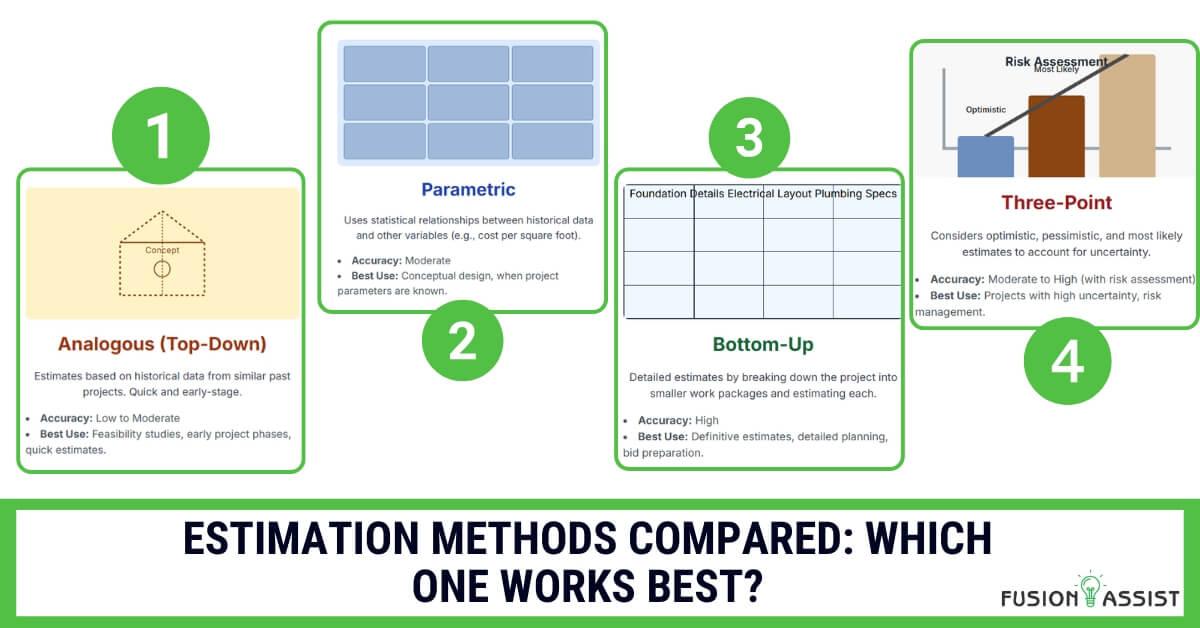
7. Apply Estimation Techniques for Different Scenarios

There are various estimation techniques that can be applied depending on the project type and
level of complexity. Techniques like analogous estimating, parametric estimating, and bottom-up
estimating each have their strengths and weaknesses. By understanding when to apply each
technique, project managers can improve accuracy and efficiency in their estimation process.

Best Practice:

  • Use analogous estimating when you need a quick, high-level estimate based on past
    similar projects.
  • Use parametric estimating when you have known variables, like cost per square foot
    that can be applied to the project.
  • Use bottom-up estimating for more complex projects where detailed, task-level
    estimates are required.

Benefits:

  • Provides flexibility to apply the best technique for the project’s needs.
  • Increases the likelihood of accuracy by matching the right method to the right project.
  • Helps save time when you need quick estimates.
07Mar

The Importance of Accurate Cost Estimation in Construction Projects

Introduction

Accurate cost estimation is one of the most critical components of any construction project.
Whether you’re working on a residential building, a commercial property, or an infrastructure
project, the ability to predict costs effectively can make or break the project. Cost overruns are a
common issue in the construction industry, often leading to delays, budget issues, and even
project failure. In this blog, we will explore why cost estimation is so important, the different
methods of cost estimation, and how technology can help improve accuracy.

The Role of Cost Estimation in Construction Projects

Cost estimation in construction is the process of forecasting the costs required to complete a
project, including materials, labor, equipment, and overhead. It is typically done at the beginning
of the project and is used as the foundation for the budget. Without accurate cost estimates, a
construction company could find itself underfunded, causing delays and financial strain.

1. Budgeting and Financial Planning

The primary purpose of cost estimation is to establish a project’s budget. Accurate estimates help
stakeholders understand the financial scope of the project before it begins. This ensures that
sufficient resources are allocated, and the financial risk of the project is minimized. A wellprepared budget enables project managers to make informed decisions about resource allocation,
timelines, and material procurement.

2. Risk Management

Accurate cost estimation plays a crucial role in managing risks. Without a clear understanding of
the potential costs involved, unforeseen expenses can arise that may derail the entire project. For
example, underestimating material costs or labor requirements can cause significant delays. By
factoring in possible risks, construction professionals can prepare contingencies to handle
unexpected situations.

3. Time Management and Scheduling

Cost estimation is also closely linked to time management. A detailed estimate helps create a
realistic timeline for project completion. It takes into account the time required for materials to
be delivered, labor to be scheduled, and machinery to be set up. Without accurate time estimates,
a project may experience delays, leading to increased costs and dissatisfied clients.

Methods of Cost Estimation in Construction

There are various methods for estimating construction costs, and each has its advantages and
disadvantages depending on the project type, size, and stage.

1. Preliminary Estimates

Preliminary estimates are often used in the early stages of a project when detailed information is
not yet available. These estimates are based on historical data and are used for initial budgeting
and feasibility analysis. They provide a rough idea of the project’s cost, but they are less reliable than more detailed estimates.

2. Unit Cost Method

The unit cost method is commonly used in construction projects where specific quantities and
costs are known. For example, if a project requires 1,000 square feet of flooring, the cost can be
calculated based on the price per square foot. This method is often used in residential and
commercial construction where material quantities are predictable.

3. Detailed Estimates

Detailed estimates involve a comprehensive analysis of every aspect of the project. This includes
measuring the quantities of materials, labor hours, equipment, and other direct and indirect costs.
Detailed estimates are more time-consuming but are typically more accurate and provide a clear
picture of the total project cost.

4. Analogous Estimating

Analogous estimating involves using data from similar past projects to predict the cost of a new
project. This method is based on historical information and is useful when little data is available
for the current project. While it is faster, it may not be as accurate as other methods because it
relies on general assumptions.

5. Parametric Estimating

Parametric estimating uses statistical data to predict the cost based on specific parameters, such
as square footage or the number of rooms in a building. This method relies on historical data and
mathematical models to calculate costs, providing a good balance between speed and accuracy.

How Technology is Improving Cost Estimation Accuracy

Advancements in technology have revolutionized the construction industry, particularly in the
area of cost estimation. The traditional methods of estimation often relied on manual calculations
and subjective judgment, but today, software and digital tools are making the process much more
accurate and efficient.

1. Estimation Software

Construction estimation software has become an indispensable tool for professionals in the
industry. Programs like ProEst, Buildertrend, and RSMeans provide pre-built databases with
pricing information, which can significantly reduce the time spent on calculations. These tools
allow estimators to input project details and quickly generate accurate cost estimates based on
current market rates.

2. Building Information Modeling (BIM)

Building Information Modeling (BIM) is an innovative technology that creates 3D models of a
construction project, allowing for more precise planning and cost estimation. BIM software
integrates various project components such as materials, labor, and timelines into one digital
model. This not only helps improve cost accuracy but also allows for better collaboration among
stakeholders.

3. Cloud-Based Solutions

Cloud-based estimation tools allow project teams to access cost data and updates in real time,
from anywhere in the world. This ensures that all parties involved in a project are working from
the most up-to-date information. Cloud-based solutions can also integrate with other project
management tools, streamlining the overall workflow and reducing the risk of errors.