Table of Contents
Construction Estimating Mistakes That Cost Contractors Money | Fusion Assist
Estimating accuracy wins bids. Commercial resilience protects profit.
Most construction projects don’t fail because the estimate was careless.
They fail because the estimate was technically correct but commercially exposed.
Construction estimating mistakes are rarely obvious. They don’t show up as missing line items or arithmetic errors. They appear later—during procurement, mobilisation, and delivery—when assumptions collide with reality and margin starts to erode quietly.
This is why experienced contractors, not just inexperienced ones, continue to struggle with estimating outcomes even when bids look solid on paper.

Why estimating mistakes are rarely obvious at submission
At tender stage, an estimate is judged by how it competes.
After award, it is judged by how it survives.
The most damaging estimating mistakes are not errors of quantity or rate. They are errors of expectation—where the estimate assumes conditions that the contract, programme, or delivery environment does not support.
This is why construction estimating mistakes often pass internal reviews and still fail commercially.
Mistake #1: Treating assumptions as background noise
Every estimate is built on assumptions. The problem is not that assumptions exist—it’s that they are rarely defended.
Estimators document assumptions in notes. Project teams rarely see them again. Contracts rarely respect them.
This is one of the most common construction estimating mistakes: assuming that clarity at bid stage translates into protection after award.
It doesn’t.
Once work begins, assumptions are either enforced or ignored. And ignored assumptions don’t disappear—they turn into unpriced responsibility.
Mistake #2: Confusing scope clarity with scope control
A detailed scope does not guarantee controlled delivery.
Many estimates define scope accurately but fail to define scope ownership. Interfaces between trades, coordination responsibilities, and sequencing obligations are often described—but not defended.
This leads directly to preconstruction estimating errors where the estimate reflects the drawings, but not the contractual reality.
After award, scope expands not because it changed—but because responsibility was never commercially anchored.
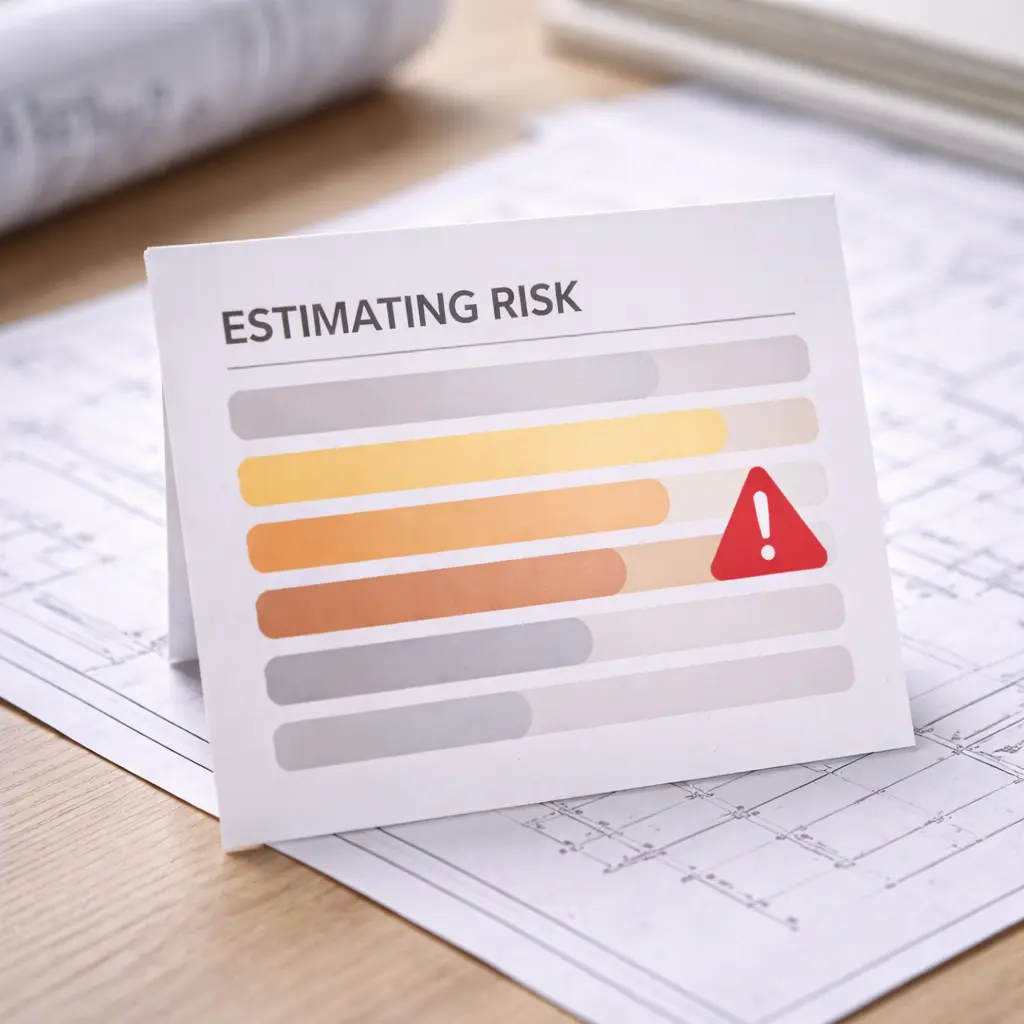
Mistake #3: Pricing risk without tracking it
Risk allowances are often included as percentages, contingencies, or buffers. Once the bid is submitted, those allowances disappear into totals.
Project teams inherit budgets, not risk logic.
This is why construction estimates fail even when they appear conservative. Risk was priced—but never monitored, never defended, and never revisited.
When risk becomes real, there is no mechanism left to absorb it without margin loss.
Mistake #4: Assuming procurement will match the estimate
Many estimates rely on:
- early market feedback
- indicative supplier pricing
- assumed availability
By the time procurement begins, conditions have shifted.
Supply constraints, lead times, and price movement expose one of the most expensive estimating mistakes: assuming procurement will behave the same way it did during tender.
The estimate didn’t lie.
The market moved.
Without flexibility or protection, margin absorbs the difference.
Mistake #5: Ignoring programme pressure in the estimate
Programme is rarely neutral.
Estimates often assume logical sequencing, stable access, and efficient workflows. Delivery rarely provides those conditions.
Programme compression forces:
- out-of-sequence work
- labour inefficiency
- extended preliminaries
These impacts rarely trigger formal change. They simply degrade productivity.
This is one of the most overlooked estimating mistakes before tender submission—pricing time as if it were fully controllable.
Mistake #6: Treating delivery efficiency as a safety net
Many estimates quietly assume performance recovery.
“If productivity dips, we’ll recover later.”
“If prelims stretch, we’ll save elsewhere.”
This mindset is dangerous.
Efficiency is not a buffer—it is an outcome. When estimates depend on future optimisation to protect margin, they transfer risk forward without defence.
Construction estimating mistakes compound when optimism replaces protection.
Mistake #7: Separating estimating from delivery accountability
One of the most systemic problems in construction is the handover gap.
Estimators finish. Projects begin. Commercial intent dissolves.
Without continuity:
- assumptions are forgotten
- risk logic disappears
- scope boundaries soften
This is not a people problem. It’s a structural one.
Estimates fail when they are treated as pricing documents instead of commercial frameworks.

Why experienced contractors still repeat these mistakes
Experience does not eliminate estimating mistakes.
It often normalises them.
When margin erosion happens gradually, it becomes familiar. Contractors adapt instead of correcting. Loss becomes manageable instead of unacceptable.
This is why seasoned firms still suffer from construction estimating mistakes—not because they don’t know better, but because the system rewards short-term wins over long-term discipline.
Estimating accuracy vs estimating resilience
Accuracy answers: Is this number right today?
Resilience answers: Will this number survive delivery?
Most estimating processes optimise for accuracy. Very few optimise for resilience.
Resilient estimates:
- defend assumptions
- track risk beyond submission
- anticipate programme distortion
- survive procurement volatility
Without resilience, accuracy alone is fragile.
The real cost of estimating mistakes
Estimating mistakes rarely cause immediate failure.
They cause:
- margin erosion
- cash flow pressure
- claim dependency
- strained client relationships
By the time the problem is visible, it is already embedded.
At that point, the estimate didn’t fail—the system did.
A more honest view of estimating success
Estimating success should not be measured by:
- bid hit rate
- turnover growth
- submission speed
It should be measured by:
- margin retention
- risk realised vs risk priced
- commercial stability post-award
Without these measures, estimating mistakes repeat quietly and indefinitely.
Final thought
Construction estimating mistakes are not about competence.
They are about exposure.
The most damaging errors are the ones that feel reasonable at submission and unavoidable during delivery.
Contractors who protect profit don’t just estimate accurately—they estimate defensively. They understand that the estimate must survive contracts, markets, programmes, and pressure.
Accuracy wins bids.
Resilience protects margin.