Table of Contents
Construction Bid Profitability: Why Winning Bids Still Lose Money | Fusion Assist
Winning work is not the same as winning profit.
Many contractors submit accurate estimates, price competitively, and still struggle with construction bid profitability once the contract is awarded. On paper, the numbers make sense. The estimate is complete. The bid is defensible. The job is won.
Yet months later, the project tells a different story. Margins shrink. Cash flow tightens. Disputes increase. The same question comes up again and again:
How did a profitable bid turn into a financial burden?
The answer is rarely poor estimating. It is almost always commercial exposure that was never actively managed.
Why construction bid profitability is misunderstood
Construction bid profitability is often treated as a mathematical outcome:
estimate accurately, price competitively, and profit will follow.
In reality, profitability is a commercial condition, not a calculation.
An estimate reflects a moment in time — based on drawings, specifications, assumptions, and expectations that exist before the contract is signed. Once the contract is awarded, those conditions begin to shift. Responsibility changes hands. Risk reallocates. Control becomes fragmented.
Contractors who rely solely on estimating accuracy often discover that winning construction bids is only the beginning of financial exposureity.
The false sense of security created by accurate estimates
Accurate estimates do three things very well:
- They quantify known scope
- They price visible risk
- They compete effectively in tendering
What they do not do is enforce commercial boundaries after award.
This creates a dangerous illusion:
“If the estimate was right, the profit should take care of itself.”
It doesn’t.
Profitability requires active defense, not passive expectation.
Where profitability begins to erode
Assumptions quietly convert into obligations
Every estimate contains assumptions. Some are explicit. Many are implied.
Before award, assumptions are tolerated. After award, they are enforced.
This is one of the core reasons why winning construction bids lose money. Items that were assumed to be:
- Coordinated by others
- Provided by the client
- Resolved later
often become the contractor’s responsibility without formal variation or compensation.
What looked like a reasonable assumption during bidding becomes an unpriced obligation during delivery.
Scope ownership expands without acknowledgment
Contracts are rarely neutral documents. They shift risk deliberately.
After award, contractors frequently discover that:
- Interfaces between trades are their responsibility
- Access constraints are “means and methods” issues
- Temporary works are assumed, not listed
- Coordination is implied, not reimbursed
None of this indicates an estimating error.
It indicates commercial exposure that was not actively managed.
The estimate is abandoned at handover
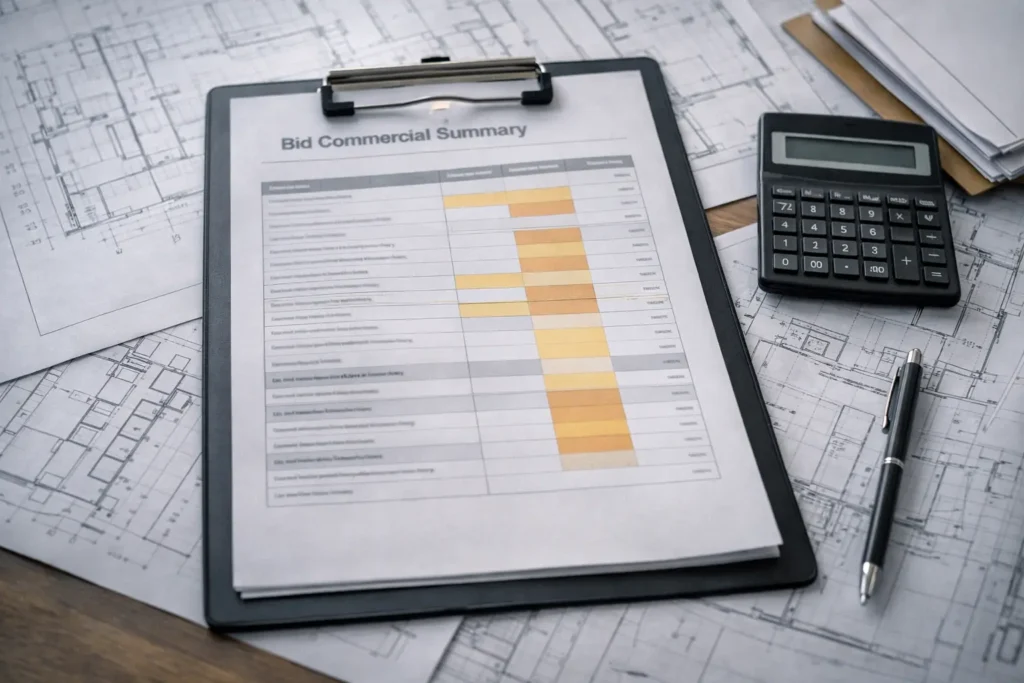
One of the most damaging moments in any project is the internal handover.
Estimators move on. Project teams mobilize. The estimate becomes a line item in a system instead of a commercial reference.
As a result:
- Scope notes are forgotten
- Risk allowances lose visibility
- Assumptions are not defended
This directly leads to construction margin loss after contract award, even when no single event feels catastrophic.
Margin erosion happens quietly — through dozens of small decisions made without commercial context.

Client expectations escalate after award
Before award, discussions are flexible. After award, delivery is assumed.
Once contracts are signed:
- Timelines compress
- Standards increase
- Responsiveness expectations rise
- Change resistance increases
Each concession feels minor in isolation. Collectively, they distort the commercial reality of the project.
This is how construction bid profitability after award deteriorates — not through failure, but through accommodation.
Why contractors keep repeating this cycle
The issue is not lack of intelligence, experience, or effort.
It is structural.
Most contractors treat estimating as a pre-contract function and delivery as a post-contract responsibility, without commercial continuity between the two.
This creates a gap where:
- Risk exists but is unmanaged
- Scope changes but is undocumented
- Margin erodes but is untracked
Construction bid profitability cannot survive in that gap.
Profitability is a leadership function, not a spreadsheet outcome
Contractors who protect profit approach bids differently.
They do not ask:
“Can we win this?”
They ask:
“Can we own this — commercially, contractually, and operationally?”
That difference is critical.
Construction bid profitability improves when:
- Assumptions are challenged, not inherited
- Scope boundaries are explicit, not implied
- Risk is tracked, not absorbed
- Project teams understand the why behind the numbers
The cost of not defending the estimate
When the estimate is not defended:
- Teams optimize for delivery speed, not margin
- Decisions favor progress over protection
- Risks are absorbed into productivity
- Claims become reactive instead of strategic
By the time the financial impact becomes visible, it is already embedded in the programme.
At that point, profitability is not lost — it has already been spent.
A different way to think about bid success
Winning a bid is an achievement.
Delivering it profitably is a discipline.
Construction bid profitability survives when the estimate remains:
- A commercial reference
- A scope boundary
- A risk register
- A leadership tool
It must guide decisions long after the bid is forgotten.
Final thought
The contractors who consistently protect margin are not the fastest bidders or the cheapest.
They are the ones who treat every bid as a commercial commitment, not just a pricing exercise.
Construction bid profitability is not decided at submission.
It is decided by what is defended — and what is allowed to slide — after the contract is signed.