
Learn how HVAC estimating works — from takeoffs to labor and material costs. This guide explains each step to help contractors prepare accurate HVAC bids with Fusion Assist.

Electrical Takeoff Checklist — Everything Contractors Need for Accurate Bids
Use this complete electrical takeoff checklist to prepare accurate bids and material estimates. Learn key steps, quantities, and best practices from Fusion Assist’s estimating experts.

Value Engineering in Construction
Learn how value engineering in construction helps contractors reduce costs without sacrificing quality. Explore stages, examples, and benefits with Fusion Assist.

Digital Takeoff vs Manual Takeoff
Discover the difference between manual and digital takeoffs — speed, accuracy, and ROI. Learn why U.S. contractors are switching to digital estimating with Fusion Assist.

Construction Estimate Cost in 2025
Discover how much a construction estimate costs in 2025. Compare real pricing for residential and commercial projects, understand cost factors, and learn how professional estimators save contractors time and money.
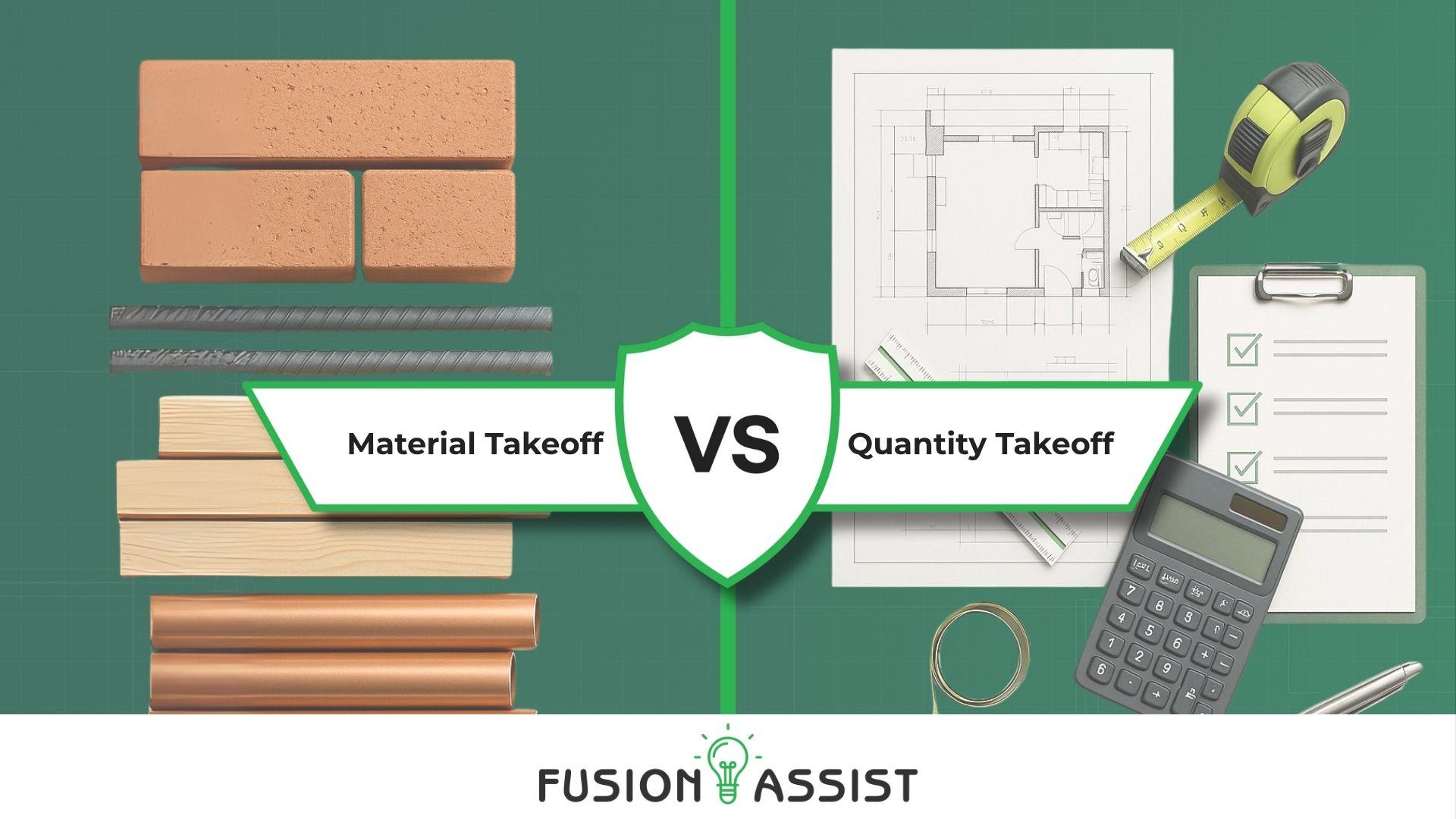
Material Takeoff vs Quantity Takeoff: 7 Essential Differences U.S. Contractors Must Know
Discover the 7 essential differences between Material Takeoff vs Quantity Takeoff. Learn how U.S. contractors can use accurate estimating methods to improve bids, reduce errors, and win more projects.

Construction Estimating
In today’s competitive construction landscape, precision is not just a goal; it’s a requirement. A successful project is built on the foundation of an accurate and detailed cost estimate. As a leading construction estimating company, Fusion Assist provides developers, contractors, and project owners in the US and UK with the critical financial insights needed to plan, bid, and build with confidence.
Our expertise transforms complex project plans into clear, actionable data, ensuring your budget is realistic and your bids are competitive.
The Construction Project Cost Breakdown
Understanding what goes into the total cost of a project is the first step toward effective budget management. A professional estimate goes far beyond a single number; it provides a comprehensive breakdown of all anticipated expenses. At Fusion Assist, every estimate we produce includes a detailed analysis of the following components:
1. Direct Costs (The “Hard Costs”) These are the expenses directly tied to the physical construction of the project.
• Materials: A detailed quantity takeoff and costing for every item, from concrete and steel to wiring and fixtures.
• Labor: The cost of the skilled workforce required to execute the construction, calculated based on man-hours and prevailing wage rates.
• Equipment: The cost of purchasing or renting all necessary machinery, such as excavators, cranes, and scaffolding.
• Subcontractor Bids: The costs associated with specialized trades like electrical, HVAC, and plumbing.
2. Indirect Costs (The “Soft Costs”) These are essential expenses not directly incorporated into the physical structure but are critical for project execution.
• Permits and Fees: Costs associated with municipal or council approvals and inspections.
• Site Management: Salaries for the project manager, site superintendent, and other administrative staff.
• Overhead: General business expenses, including insurance, office rent, utilities, and administrative support.
• Design & Engineering Fees: Costs for architects, engineers, and consultants involved in the project.
3. Contingency No project is without its surprises. A contingency fund, typically 10-20% of the total direct and indirect costs, is a crucial allowance for unforeseen challenges, changes in scope, or market price fluctuations. We help you calculate an appropriate contingency to protect your project from risk.
How to Estimate Construction Costs: Our Methodology
Estimating construction costs is a sophisticated process that evolves with the project’s lifecycle. Our team is proficient in multiple methods to provide the right level of detail at the right time.
Stage 1: Order of Magnitude / Square Foot Estimate Used in the very early stages of planning, this method provides a ballpark figure based on the project’s size (square footage or metres) and intended use. It’s ideal for initial feasibility studies.
Stage 2: Systems & Assemblies Estimate As the design develops,
this more detailed method estimates costs based on major systems (e.g., the entire roofing system, the foundation, the HVAC system). It provides a more refined budget for decision-making during the design phase.
Stage 3: Unit Price / Detailed Takeoff Estimate
This is the most accurate and comprehensive method, forming the core of Fusion Assist’s services. Our estimators perform a meticulous “takeoff,” quantifying every single material component and labor task from the project blueprints. Each unit is then assigned a precise cost. This granular detail is essential for creating competitive bids, managing procurement, and controlling the final project budget.
The Construction Estimator:
Your Project’s Financial Strategist
What is a construction estimator? A professional estimator is far more than a number cruncher; they are a vital strategic partner for your project. The role of an estimator on your team is to:
• Provide Financial Foresight: By identifying and costing every element of the project, they create a clear financial roadmap from start to finish.
• Manage Risk: They identify potential financial risks, such as material price volatility or labor shortages, allowing you to plan accordingly.
• Optimize Budgets:
A skilled estimator can suggest alternative materials or construction methods (value engineering) that can reduce costs without compromising quality.
• Ensure Competitive Bidding: For contractors, our detailed estimates provide the confidence to submit bids that are both competitive enough to win the job and robust enough to secure a profit.
The team at Fusion Assist embodies this role, bringing decades of combined experience across a wide range of residential, commercial, and industrial projects in both North America and Europe.
Partner with Fusion Assist for Estimating Excellence
Whether you are validating a budget, preparing a bid, or seeking to control project costs, our expert team is ready to provide the clarity and accuracy you need.
To learn more about our commitment to precision and client success, please visit here.
For a detailed, data-driven estimate on your next construction project, contact us today.
• Request a Quote via our Online Form: Contact Us
• Speak with an Estimator:
o UK Office: (020) 7664 8623
o USA Office: (214) 308-1582
• Email Your Plans: info@FusionAssist.com

Why Accurate Commercial Construction Estimating in Atlanta is Crucial for Your Bottom Line
Introduction
In the dynamic Atlanta construction market, the skyline is constantly evolving. From sleek high-rises in Midtown to massive logistics centers near Hartsfield-Jackson, opportunities for commercial contractors are everywhere. However, there is a lot of risk involved with a high reward. In this competitive environment, the single most important factor that determines whether a project is a resounding success or a financial disaster is the accuracy of your initial estimate. An imprecise bid isn’t just a miscalculation; it’s a direct threat to your company’s profitability and reputation.
Many contractors believe that winning a bid is all about having the lowest price. While cost is a factor, savvy developers and project owners in Atlanta are looking for value, reliability, and professionalism. An estimate that is made swiftly, is imprecise, full of assumptions and gaps is a warning. On the other hand, a well-detailed, clear, and accurate bid creates instant confidence. It demonstrates that you have a deep understanding of the project scope, have accounted for all variables, and are capable of delivering on time and on budget. That is how you save your bottom line and develop a sustainable business.
This book is the guide to the aspiring commercial contractor in Atlanta, GA, who desires to get beyond merely winning work to winning the right work, profitably. We will explore why precision in commercial estimating is non-negotiable, break down the anatomy of a winning bid, and show how leveraging expert construction takeoff services in Atlanta, like those offered by Fusion Assist, can become your most powerful tool for growth.
The True Cost of an Inaccurate Bid
A wrong estimate leads to a chain reaction of issues that may cripple a project and your company. It is much more than a figure on paper, it is the financial basis of the whole construction. Once that foundation is weak then everything built on it is in danger.
Risk 1: Devastating Cost Overruns
This is the threat that is the most evident. If you underestimate the cost of materials, labor, or equipment, that money has to come from somewhere—and it’s usually your profit margin. The Atlanta market is a busy market, and the prices of materials and the availability of labor may change, and a minor error in your initial bid can end up costing you a lot by the time the project is completed. Avoiding cost overruns starts with a meticulously detailed estimate.
Risk 2: Damaged Client Relationships and Reputation
Think of a customer midway through a job with, say, 50 percent of the job done and telling the customer you need more money because there was an unexpected cost that you did not anticipate. This conversation instantly erodes trust and can permanently damage your professional reputation. In a city like Atlanta, where word-of-mouth is powerful, a reputation for change orders and budget issues can be devastating to future business.
Risk 3: Poor Project Planning and Execution
Your estimate is the plan of your project. It lets you know how to buy, how to staff, how to coordinate subcontractors. A wrong estimate results in a wrong plan. You may either order insufficient steel, book the wrong amount of electricians or have equipment idle. This on-site mess causes delays, wastage of resources and a stress-ridden team, which adds to the financial losses.
Risk 4: A Declining Bid-Hit Ratio
A habit of over-bidding will result in the loss of jobs. When you continually underbid you win the work but not the money. Neither of the two scenarios is sustainable. Accurate construction bids in Atlanta are about finding the sweet spot: a price that is competitive enough to win the work and comprehensive enough to ensure construction project profitability.
The Anatomy of a Winning Commercial Estimate- Atlanta
 A professional and accurate commercial estimate is a detailed, multi-faceted document. It does not leave any stone unturned and gives a clear transparent description of the whole project. These are the main elements that any high-quality estimate should have.
1. Detailed Material Takeoffs
This is your quantitative basis of your bid. It involves meticulously calculating the exact quantity of every single material needed, from the cubic yards of concrete and tons of structural steel to the number of light fixtures and linear feet of wiring. This is where precision is paramount and where using professional construction takeoff services in Atlanta can provide a massive advantage.
2. Accurate Labor Costing
You have to take into consideration the fully burdened labor cost. This is not only the hourly pay but also the payroll taxes, insurance and benefits of all trades involved. Moreover, you must estimate the required man-hours of each task properly, which should take into consideration the difficulties of commercial construction in a competitive market such as Atlanta.
3. Comprehensive MEP and Specialty Trades Analysis
Mechanical, Electrical, and Plumbing (MEP) systems are often the most complex and costly parts of a commercial build. A winning estimate requires a detailed breakdown from a specialized MEP estimating service. The same goes for other critical trades like structural steel, concrete, and masonry. An educated guess is a recipe to disaster.
4. Indirect Costs and Overheads
Direct material and labor are not the only elements of a profitable bid. You must accurately account for all indirect costs, including:
- Salaries of project management and administrative staff.
- Fees, insurance and permits.
- Such facilities as trailers and sanitation on-site.
- Renting of equipments and fuel expenses.
- A contingency fund for genuinely unforeseen issues.
5. A Clear and Professional Proposal
The closing estimate ought to be done in a formal manner. It must specify the entire work to be done, give inclusions and exclusions, give a projected timeline, and payment terms. This document is a direct reflection of your company’s professionalism.
The Fusion Assist Advantage: Technology-Driven Precision
 In the modern day market, manual takeoffs using scales and highlighters are inefficient, time consuming and subject to human error. The leading Atlanta construction cost estimators leverage technology to deliver speed and unparalleled accuracy. This is the core of the Fusion Assist service.
We combine the expertise of seasoned estimators with the power of advanced digital takeoff solutions. We have a procedure that will give you a competitive advantage and offer you bottom line protection.
Case Study: Winning a Competitive Office Renovation in the Buckhead District
Client
An Atlanta-based general contractor specializing in high-end commercial interiors.
Challenge
One of the major tech companies in the country was opening a new regional head office in a high-profile office building in the Buckhead area. The bid was highly competitive, and the client needed to submit a bid that was not only sharp on price but also exuded confidence and professionalism to win over the sophisticated client. They couldn’t afford to miss a single detail in the complex MEP and high-end interior finishing plans.
Fusion Assist Solution
The contractor sent the complete set of architectural and engineering plans to Fusion Assist. We have conducted a very detailed analysis with the help of digital takeoff software. We presented a full list of materials, including structural elements of the new layout and the exact amount of glass partitions, custom flooring, and sophisticated lighting. Our MEP estimating specialists broke down the HVAC and electrical systems, ensuring every component was accounted for.
Result
Within 48 hours, the contractor had a comprehensive, bid-ready estimate. The extent of details enabled them to present their bid with confidence, and they could answer the questions posed by the client accurately. Their bid was professional and the most comprehensive and this is why they were awarded the contract and not necessarily because they were the lowest. The accuracy of the initial estimate meant the project proceeded smoothly, with no costly change orders, cementing a strong relationship with a high-value corporate client.
Conclusion: Build Your Atlanta Business on a Foundation of Accuracy
In the high risk business of commercial construction in Atlanta, your estimate is your bond. It is the bargain that you give to your client and the financial plan of your company. Getting it right is the difference between building a legacy of profitable, landmark projects and struggling with the constant stress of cost overruns and unhappy clients. With the precision, the details of every component, and the power of expert services, all projects you win are one step toward the more profitable and sustainable future.
Stop leaving money on the table or risking your reputation with guesswork. Let Fusion Assist provide the accurate, detailed, and professional commercial construction estimates you need to thrive in the Atlanta market.
Frequently Asked Questions (FAQs)
What is the most commonly overlooked cost in commercial estimates?
Indirect costs are frequently underestimated. The laser-focused contractors tend to overlook the project management, insurance, on-site rentals, and administrative overhead costs and only focus on direct material and labor (the sticks and bricks). These costs can easily add 15-20% to a project’s total, and underestimating them can wipe out a profit margin.
What percentage do I put as contingency in a commercial pricing?
The common contingency amount of a commercial project is between 5-10 percent of the total direct costs. The percentage will vary depending on the complexity of the project. A simple warehouse construction could be around 5 percent and a complicated renovation of an old building in Atlanta could be 10 percent or more depending on the risk of unexpected problems.
What is value engineering and how does it relate to estimating?
Value engineering is the process of analyzing a project’s design to find less expensive alternatives without sacrificing quality or function. An elaborate estimate is important in this process. By having a precise breakdown of costs, you can identify high-cost areas and suggest alternative materials or construction methods (e.g., using a different type of structural steel or a more efficient HVAC system) that provide better value to the client.
How can I improve my bid-hit ratio?
Improving your bid-hit ratio isn’t about bidding lower; it’s about bidding smarter. This can be done by being selective in the projects you bid on, that is, ensure they are within your areas of expertise. Above all, it involves the submission of very professional and precise bids. The more detailed and transparent the estimate appears to the client, the more they will trust it and become more confident in choosing you even when you are not the lowest bidder.
Why can’t I just use square-foot pricing for a commercial estimate?
Square-foot pricing is useful for very early, conceptual budgets but is dangerously inaccurate for a formal bid. There is great variance in commercial buildings. A high-end office has vastly different MEP, interior finish, and structural requirements than a simple storage facility of the same size. The accurate cost of a certain project can only be determined through a component based estimate.

Comprehensive Construction Estimation in Chicago, IL | A Contractor’s Ultimate Guide
Introduction
The skyline of Chicago itself is a symbol of its unstoppable development rate, and this is why its construction industry is extremely profitable and at the same time extremely challenging. For a general contractor in Chicago, every project—from a commercial build-out in the Loop to a new industrial facility in the suburbs—is a high-stakes endeavor. Here the distinction between a landmark success and a cautionary tale is frequently made by the quality of your initial estimate. A “good enough” bid simply won’t cut it; you need a truly comprehensive construction estimate that serves as your roadmap to profitability.
Most contractors get into the trap of thinking that an estimate is merely a price label that is going to secure a contract. As a matter of fact, a comprehensive estimate is a strategic document. It is your plan, it is your risk assessment and it is your guarantee to the client, all in one. It demonstrates your expertise, justifies your costs, and shields your business from the devastating impact of cost overruns. In a market as complex as Chicago, with its unique labor dynamics and stringent building codes, a detailed and accurate bid isn’t just an advantage—it’s a necessity.
This guide is designed to be the definitive resource for construction bidding in Chicago, IL. We will dissect what “comprehensive” truly means, explore the essential pillars of an unshakeable estimate, and demonstrate how partnering with a premier Chicago construction estimator like Fusion Assist can elevate your bidding process from a necessary chore to a powerful engine for growth.
What Does “Comprehensive Estimation” Really Mean?
An overall estimate is much more than a list of materials and an all-in-lump sum of labor. It is a comprehensive financial model of the whole project life. It’s a document that anticipates challenges, accounts for every detail, and leaves no room for doubt or ambiguity.
In the Chicago market context this implies that your estimate should consider:
- All Project Phases: From the initial conceptual budget during preconstruction to the final, detailed bid.
- Localized Costs: Factoring in the specific costs of materials, equipment, and labor (including Chicago union labor costs) in the region.
- Regulatory Compliance: Adhering to the City of Chicago’s building codes and Illinois construction regulations.
- Risk Management: Identifying potential risks, such as weather delays or logistical challenges in a dense urban environment, and building in appropriate contingencies.
A real thorough estimate is a story. It demonstrates to the client that you have thought of every detail and are ready to go with every eventuality and it makes you a real professional right at the beginning.
The Core Pillars of a Comprehensive Chicago Estimate
 To build an estimate that is both competitive and profitable, you must focus on four unshakable pillars. The failure to develop any of them or failure to develop them adequately may collapse the whole structure of your bid.
Pillar 1: Precision Material Takeoffs
Consider the material take off as the foundation of your whole bid. It is the painstaking procedure of measuring all and any of the items needed in the project. This isn’t just about counting bricks and studs; it’s about a detailed analysis of blueprints to determine:
- Structural Components: The exact tonnage of structural steel and cubic yards of concrete.
- MEP Systems: The linear footage of piping, wiring, and ductwork, plus the count of all fixtures and units.
- Interior and Exterior Finishes: The square footage of drywall, flooring, roofing, and facade materials.
An error here can lead to costly last-minute material orders or wasteful overages. Utilizing professional construction takeoff services in Chicago that employ digital software ensures this foundational step is flawless.
Pillar 2: Nuanced Labor Costing
Labor is a very complicated variable in Chicago. An extensive estimate will entail a thorough knowledge of the domestic labor market. This includes:
- Burdened Labor Rates: You must calculate the fully burdened cost, which includes not just the base wage but also payroll taxes, workers’ compensation, general liability insurance, and contributions to union benefits and pension funds.
- Productivity Rates: You need to realistically project how long tasks will take. This may be affected by logistics of the sites, the experience of the crew, and even the notorious Chicago weather, which can affect exterior work months at a time.
- Union vs. Non-Union: Understanding the specific work rules and jurisdiction of different trade unions is critical to avoiding disputes and accurately forecasting costs.
Pillar 3: Factoring in All Indirect Costs & Overheads
This is where many contractors lose their profit margin. A winning bid must account for every cost, not just the direct ones. These general conditions and overheads include:
- Project Management: Salaries for project managers, superintendents, and administrative staff.
- Site Logistics: Costs for fencing, security, on-site trailers, sanitation, and material hoisting in tight urban spaces.
- Permits and Fees: The specific costs associated with securing permits from the City of Chicago Department of Buildings.
- Equipment and Insurance: Rental costs for cranes and other equipment, as well as the project-specific insurance policies required.
Pillar 4: Incorporating Risk and Contingency
No project goes exactly as planned. A comprehensive estimate acknowledges this reality by including a contingency fund. This isn’t a “slush fund”; it’s a calculated amount designed to cover genuinely unforeseen circumstances. For a Chicago project, this could include:
- Unexpected site conditions discovered during excavation.
- Supply chain disruptions affecting material delivery.
- Weather-related delays that push the schedule back.
A well-calculated contingency protects you from absorbing the cost of these issues and shows the client that you are a prudent and realistic planner.
Case Study: A Complex Mixed-Use Development in the West Loop
Client
A general contractor in Chicago that wants to enter bigger and more complicated projects.
Challenge
A new mixed-use development project in the trendy West Loop neighborhood was up for bid. The project involved complex structural steel, high-end residential finishes, and ground-floor retail space, all on a tight urban footprint. The in-house team of the contractor was overworked, and they were aware that one mistake would turn their bid uncompetitive or unprofitable.
Fusion Assist Solution
The contractor partnered with Fusion Assist. They forwarded to us all the plans and our team got down to work. Using digital takeoff tools, we generated a precise bill of materials for every trade. Our estimators, using a localized database of Chicago construction costs, applied accurate, fully burdened union labor rates and factored in the logistical costs of working in a congested area.
Result
In under 48 hours, the contractor received a complete, professional, and highly detailed bid package. The accuracy and the clearness of the estimate enabled them to submit their proposal with complete confidence. They secured the contract and they attribute it to the professionalism of their bid and thoroughness of their bid which made them stand out among the rest. The project was done under budget and this greatly improved their reputation and set them up to do such large scale projects in the future.
Conclusion: Build Your Chicago Legacy on a Foundation of Certainty
In the competitive construction industry of Chicago, your estimate is not just a bid, but the most important business tool. It is the basis of the profitable projects and reputation that will last. By moving beyond simple quotes to create truly comprehensive estimates—ones that are detailed, accurate, and account for local complexities—you position your company for sustainable success.
Stop gambling with your profitability. Takes confidence in the confidence that comes from precision. Let Fusion Assist provide the expert, technology-driven comprehensive construction estimation in Chicago that will empower you to bid smarter, win more, and build with confidence.
The Fusion Assist Edge: From Manual Effort to Digital Excellence
 Previously, estimators would sit days on end with rulers and yellow markers over blueprints. Not only was this manual process time-consuming, but it also had the chance of human error. In the contemporary world, technology offers a winning edge to the most successful contractors.
Fusion Assist is at the forefront of this evolution. We provide preconstruction services for Chicago contractors that transform the bidding process. By combining the power of advanced digital takeoff software with the insights of expert estimators, we deliver unparalleled accuracy and speed.
Stop gambling with your profitability in the high-stakes Chicago construction market. Contact Fusion Assist for the comprehensive, technology-driven estimate you need to bid with certainty and win.
Frequently Asked Questions (FAQs)
How do you handle union vs. non-union labor in a Chicago estimate?
A comprehensive estimate requires a detailed understanding of the project’s labor requirements. We examine the project specifications to find out whether there is a Project Labor Agreement (PLA). We then use the proper, fully burdened wage and benefit rates of the appropriate Chicago-area trade unions on each specific task and we are 100 percent compliant and accurate in our costs.
What’s a typical contingency for a renovation in an older Chicago building?
For complex renovations in older Chicago buildings, a contingency of 10-15% is often prudent. Such projects are more likely to discover unexpected problems such as toxic substances, old wiring that is not up to the standards, or structural defects that were not apparent in the preliminary inspection. An increased contingency gives it a needed cushion.
How do digital takeoffs improve accuracy over manual methods?
Digital takeoff software allows estimators to trace plans directly on a screen, with the software automatically calculating lengths, areas, and volumes. This prevents the possibility of human error in manual calculations, it is impossible to overlook any area and it is simple to make adjustments in case of plan revision. The result is a faster, more precise, and more easily verifiable material list.
What’s the difference between a conceptual estimate and a detailed bid estimate?
A conceptual estimate is a high-level budget created during the very early stages of a project, often based on limited information and historical square-foot costs. A detailed bid estimate, which is what we specialize in, is created from a complete set of plans and specifications. It involves a full material takeoff and a detailed breakdown of all labor, equipment, and indirect costs, providing the accuracy needed for a binding contract.
How does Fusion Assist ensure its cost data for Chicago is current?
We constantly follow the situation in the Chicago construction market. We keep the material and equipment costs up-to-date by keeping in touch with the local suppliers constantly. We also subscribe to services that provide the latest union labor rates and benefit schedules, ensuring that every estimate we produce reflects the most current, real-world costs of building in the Chicago area.

Maximize Your Bid-Win Ratio: A Contractor’s Guide to Expert Estimation in Birmingham
Introduction: The Battle for Bids in Birmingham’s Booming Market
Birmingham is a dynamic city. Whether it is the ambitious Paradise redevelopment and the HS2 Curzon Street station or the emerging residential developments in Digbeth and the Jewellery Quarter, the landscape is full of building activity. This is a rich source of opportunity to contractors in the West Midlands. But as there is opportunity so there is fierce competition. In this crowded marketplace, every tender is a battle, and the single most important metric that defines a contractor’s commercial success is the bid-win ratio. This is a basic percentage which is calculated by dividing the number of projects won by the number of projects bid on and is a critical key performance indicator (KPI). It is a direct indicator of the efficiency, competitiveness and positioning of your company in the market.
A low bid-win ratio is more than just a series of disappointments; it’s a significant drain on your most valuable resources: time, money, and morale. The procedure of creating a detailed, correct bid is immensely resource-heavy, and may cost thousands of pounds in estimator wages and clerical time. In case of losing a bid every time, such an investment returns nothing. The answer that many contractors think is to bid lower, which in most cases can result in a race to the bottom and winning work that is unprofitable and is harmful to the business in the long term. The real key to improving your bid-win ratio isn’t about being the cheapest; it’s about being the most professional, credible, and strategic bidder.
This guide will explore the strategic importance of the bid-win ratio and how leveraging expert construction estimation services can be the single most effective strategy for maximizing it. We will take it apart and examine the anatomy of a winning bid, how exactness and professionalism affects the decisions of your clients and give a practical case study to show how by partnering with a specialist service like Fusion Assist you can turn your bidding process into a cost-effective growth engine rather than a costly gamble.
The Vicious Cycle of a Poor Bid-Win Ratio
 A consistently low bid-win ratio (typically considered to be below 1 in 5 or 20% for competitive tenders) is a symptom of deeper issues and creates a negative feedback loop that can be difficult to escape. Being familiar with them is the initial step in correction of the problem.
The Financial Drain of Wasted Resources
This is the most tangible thing. Think of what it costs to put up one, moderately complex bid:
- Estimator’s Time: Tens of hours of takeoff time, obtaining quotes and putting together the bid. At an average salary, this can easily amount to £1,500 – £3,000 per bid.
- Administrative Support: The amount of time wasting on submitting and preparing tender documents.
- Software and Data Costs: Estimation and pricing databases subscription. When you lose four out of five bids, you are effectively spending £6,000 – £12,000 in unrecoverable costs for every project you win. This directly bites off the margins of the successful project and places a huge burden on your overheads.
Reduced Bidding Capacity and Missed Opportunities
When your estimating team is always busy preparing the bids and the bids fail, the team has no space to explore other opportunities, which could be more appropriate. You might even have to reject good tenders just because you lack the resources to make up a good submission within the time. That reactive, always-on-the-back-foot strategy does not allow you to be picky and to strategically pursue the projects that best align with your company in terms of its skills and profit objectives.
Damage to Market Perception and Morale
Losing bids continually may influence the reputation of your company in the market. Clients and developers can start thinking of you as an underbidder who is not a serious competitor. In the internal front, it can be devastating in terms of morale. An estimating team that rarely sees their hard work translate into success can become demotivated, leading to a drop in quality and a “going through the motions” attitude, which only serves to worsen the bid-win ratio further.
The Anatomy of a High-Conversion Bid
The use of the lowest number does not guarantee a company to win a construction bid in a sophisticated market such as Birmingham. Senior clients are deciding on the basis of a set of criteria indicating competence, reliability and professionalism in your submission. A high-conversion bid performs well in four aspects.
Forensic Accuracy and Detail
A successful bid is one that does not give any doubts. All quantities are accurate, all materials are defined and all labour hours are counted. This detail shows that you have studied the project in detail and you know what complications it involves. It assures the customer that you are not making up the price and that you have a sound basis to charge the price you do and it makes the customer less afraid of being bombarded with change orders and price increases in the future.
Professionalism in Presentation
Your company is directly reflected in your bid document. A professional, clear, and well-formatted submission is distinguishable in comparison with an improvised spreadsheet. It must be easy to read through with a clear scope of works, a breakdown of costs and a clear list of what is included and not. This professionalism is an indication that you are a well organised company with details and easy to do business with.
Transparent Risk Management
A sophisticated bid does not deny that risks do not occur; it reveals them and describes how they will be controlled. This can also involve drawing to your clients’ attention potential ground condition issues or an investigation plan, or showing in advance of the construction programme that you have been talking to suppliers for specialist materials which are long lead times. Also, including a well-backed up contingency sum is a sign of a sensible contractor. This openness creates huge trust.
Demonstrable Value, Not Just Price
The winning bid is able to convey value. This can be done by making a value engineering proposal, which is an idea to use a cheaper material or a cheaper way of constructing without compromising any quality. It can also be proven by pointing out the fact that your team has a certain experience with the similar projects or that your supply chain is strong. It is aimed at ensuring that the client does not focus on who is the cheapest. to who will give the best “all around value and the least risk”?
How Expert Estimation Services Directly Impact Your Bid-Win Ratio
This is where a strategic collaboration with a professional estimation service turns out to be a game-changer. By outsourcing this critical function, you address the root causes of a poor bid-win ratio and fundamentally enhance the quality and effectiveness of your submissions.
Speed and Volume: Bidding on More of the Right Projects
In this way, you can expand your bidding power immediately by using an outside group of estimators. An estimate such as that provided by Fusion Assist can be reversed within 48-72 hours, a small portion of the time an over-strained in house team may take. With this new efficiency you can:
- Be More Selective: You will be able to review more tenders and be more selective on the ones that you will bid on that are a perfect match of your expertise and have the highest profit potential.
- Never Miss a Deadline: You will be able to take up last minute opportunities without affecting the quality of your submission. This change of attitude in terms of reactive to proactive bidding strategy is the key to increasing your win rate.
Unparalleled Accuracy: Reducing Risk and Inspiring Client Confidence
Specialist estimation services are data breathers. They integrate the strength of digital takeoff software with regularly refreshed material and labour costs databases. This provides an accuracy that is hard to be achieved by a general contractor internally. This precision directly boosts your bid-win ratio by:
- Building Trust: Having a forensically detailed bid will make clients have enormous trust in your numbers. They tend to go with a bid they feel comfortable with even though it is not the lowest.
- Reducing Your Own Risk: You are able to bid more competitively and tighter with the correct costs without jeopardizing your profit margin. You do away with the necessity of putting on excessive padding to offset uncertainty which puts you out of the game many times.
Professional Presentation: Standing Out from the Competition
Bid documentation is also the specialty of the expert estimation services. They provide professionally prepared reports that are easy to read and are presented in a format that is likely to impress the quantity surveyor or the project manager of a client. What you get in a package delivered by a service such as Fusion Assist is simply a bid-in-a-box with takeoffs, cost overviews, and clearly defined scopes. When you present this quality of professional documentation, you already place yourself above your competitors who will present a one-page price quote.
Strategic Insights: Moving Beyond Raw Numbers
The most effective estimation services are strategic partners not number crunchers. Their estimators are experienced in numerous projects, and they can provide useful information. They are able to highlight the possible design risks, opportunities where value engineering can be done and also give benchmark information to aid you in determining whether your prices are competitive. Such a strategic contribution will enable you to make a smarter bid that will show your proactive attitude toward problem-solving.
Real-World Application: The Fusion Assist Advantage in Practice
The Client and the Challenge
A mid-sized Birmingham contractor was struggling with their bid-win ratio, which had fallen to around 1 in 8 (12.5%). Their estimator in-house was overwhelmed and their quotations hurried and not detailed enough to compete with the bigger companies. They were invited to tender for a £5 million mixed-use development in Digbeth, involving the refurbishment of a historic industrial building and the construction of a new-build apartment block behind it. They were aware that they would not be able to win with their usual strategy.
The Fusion Assist Solution in Action
Fusion Assist was hired by the contractor to take care of the whole estimate.
- Rapid and Dual-Focus Takeoff: Fusion Assist assigned two estimators to the project: one specializing in heritage refurbishment and the other in new-build residential. They performed a rapid but detailed digital takeoff of both elements, accurately capturing the complexities of each.
- Risk Identification: The report of the service indicated the major risks, such as the possible expense of the specialist brick-cleaning of the historic facade and the extended lead time of the mentioned German-made window systems. They gave them budgetary allocations on these items.
- Value Engineering Proposal: Fusion Assist identified that an alternative, UK-based cladding system for the new build could offer a £75,000 saving with no compromise on aesthetic or performance and a shorter lead time.
- Professional Bid Package: The contractor was supplied with a complete bid package in a period of three days. It comprised individual, detailed costings of the refurbishment and new-build components, a clear risk register and the value engineering proposal as a formal addendum.
The Result: A Strategic Win
The Fusion Assist package was filed by the contractor. The proactive risk management and the depth of detail were the factors that impressed the client greatly during the tender review. Although two other bids were a little lower on the headline price, neither had shown the most relevant risks nor provided a sensible value engineering alternative. The bid by the contractor was selected by the client because it made them most confident of the successful outcome of the project. The contractor not only won a profitable project but also established a new, more effective bidding process, subsequently improving their overall bid-win ratio to 1 in 4 over the next year.
Conclusion: Bid Smarter, Not Just Harder
In Birmingham’s competitive construction market, your bid-win ratio is the ultimate measure of your commercial effectiveness. A bad ratio is a waste of resources that suppresses development and spirits. The answer is not to increase the number of bids you prepare, but to prepare bids with an improved quality, accuracy, and professionalism as a fundamental requirement. There is no more direct and effective way than using the speed, accuracy and tactical insight of a professional construction estimation service to realise this. Through the assistance of a specialist such as Fusion Assist, you turn your bidding into a strategic tool, turning it into a resource-saving activity enabling you to win more of the right projects and develop a more profitable, sustainable business.

Stop letting a low bid-win ratio drain your resources and morale. It’s time to transform your bidding process from a costly gamble into a strategic growth engine. Partner with Fusion Assist for the speed, accuracy, and professionalism that wins profitable contracts in Birmingham’s competitive market. Contact us today to build your next winning bid.
Frequently Asked Questions (FAQs)
What is considered a “good” bid-win ratio in construction?
This is sector specific but in the case of competitively tendered projects, 1:3 to 1:5 (33% to 20%) is deemed as healthy. This must be much higher in case of negotiated work or projects where there is an existing relationship. When the ratio of competitive bids is always less than 1 in 6 there is a good indication that your bidding process has to be looked at strategically.
Wouldn t an estimation service be another expense to my bids?
Although the service has a fee attached to it, one should not consider it as a cost but as an investment. The fee for a professional estimate (e.g., £1,000 – £2,500) is often less than the cost of your own in-house estimator’s time. What is more important is that with the help of the service you will win one more project you would have lost, so the service will pay itself many times over and leave your internal resources free.
Could an outsourced service have a clue on the overheads and profit targets of my business?
Yes. Another important element of the onboarding procedure with such a service as Fusion Assist is their familiarity with your business structure. You give them your percentages that you require in overheads and profit and they apply these percentages to the base costs which they calculate. The last offer is your personal financial model.
Will the outsourcing of the bidding process make me lose control of the process?
No, you become in control. The outsourcing of the time-consuming activities of takeoffs and pricing allows you to concentrate on the high-level strategy. Instead of being lost in spreadsheets, you can use your time to review the final numbers, perfect the value engineering proposals and develop relationships with the client.
Should it be a new in-house estimator or a third party service?
The cost of employing a new full-time estimator would be high in the long-term (salary, NI, pension, equipment, training) and it will not resolve the issue of variable workloads. A third party service offers a scalable flexible solution. You only pay when you use the service and you can increase or reduce your bidding capacity in seconds to meet the rate of tender opportunities.